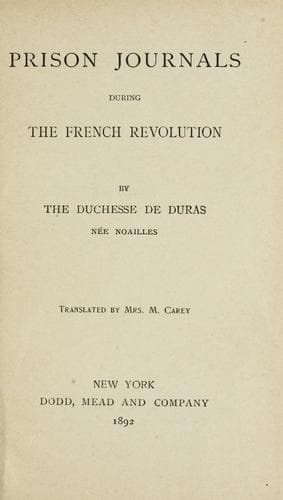
Prison Journals During the French RevolutionDuras, Louise Henriette Charlotte Philippine (de Noailles) de Durfort, duchesse de
History
Prison Journals During the French Revolution
Duras, Louise Henriette Charlotte Philippine (de Noailles) de Durfort, duchesse de
France -- History -- Revolution, 1789-1799 -- Personal narratives
All this caused me great grief. I felt more keenly than ever how much
my parents needed me, and I again sent in applications to be allowed to
go to them; they were fruitless. Fortunately they had with them my
sister-in-law, the wife of Louis, Vicomte de Noailles, whom they valued
as she deserved; but as she was obliged to take care of Madame d'Ayen,
her mother, and Madame la Maréchale de Noailles, her grandmother, who
were lodging with her, she could not do very much for my parents.
Consequently they were left entirely alone, my father then eighty and
my mother sixty.[5] Their forlorn situation was constantly before my
mind. One day as I was intensely occupied with thoughts of them, I
heard a great noise in the courtyard; I looked out, and saw a convoy
enter containing a hundred and fourteen persons from Neuilly-sur-Seine.
They had been compelled to pass by the camp of Robespierre's disciples,
who had shouted terrible threats at them. As they had received no
orders to kill the prisoners, they contented themselves with
overwhelming them with threats and insults. The convoy was composed of
a great many nobles who had established themselves in the village of
Neuilly on account of the _lettres de passe_. (A decree had compelled
all nobles who were not imprisoned in Paris to go away several leagues
from the city.) A most strange thing to happen at such a time was, that
some persons who were not of noble blood, but who wished to be
considered so, obeyed this decree, which had no reference to them at
all. The servants of the nobles had been arrested with them; and with
them were also people of all conditions, among them six nuns of the
Visitation,--one of whom was Madame de Croï, sister of Madame de
Tourzel. All of these unfortunate creatures were left a whole day in
the 'mouse-trap.' I learned that Madame de Choiseul, the mother, Madame
Hippolyte de Choiseul, and Madame de Sérent were also of the party. The
whole company were searched in the strictest manner. At last, at seven
o'clock in the evening, they were put into lodgings. The nuns, to their
dismay, were put on the sixth floor, with twenty-five persons; and to
make them more wretched, they were put with the lowest creatures. All
belonging to this convoy suffered extremely from hunger. We gave them
what we could. I remember that I made for Mesdames de Choiseul a panado
which they thought delicious. Bread and wine were usually all that was
allowed to be offered to the new-comers. This is a minute detail, and
is intended to show the destitution which existed in our prison. I have
seen poor women, brought from the suburbs of Paris, sleeping on the
tables in the refectory. The greatest attention we could bestow upon
people was to give up our mattresses to them while they were waiting
for theirs.
Public-domain text, read in full here on John Shaqi.
Reviews
Reviews
No reviews yet
Be the first to share your thoughts on this work.
Join the Discussion
Join the discussion
Sign in to leave a comment or review.
Sign InorCreate an account