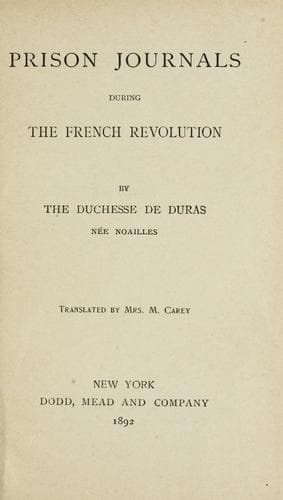
Prison Journals During the French RevolutionDuras, Louise Henriette Charlotte Philippine (de Noailles) de Durfort, duchesse de
History
Prison Journals During the French Revolution
Duras, Louise Henriette Charlotte Philippine (de Noailles) de Durfort, duchesse de
France -- History -- Revolution, 1789-1799 -- Personal narratives
Accordingly she came into my room early in the morning, and I no longer
doubted what my misfortune was. I read the whole story in her face. She
did not tell me of the death of both at once; she waited awhile before
telling me of the other. I can never express the grief I felt,--the
horror of thinking of such virtue, perfect charity, and honour upon the
scaffold! My parents' goodness to me, their tenderness, the immense
force of their examples, the lessons they taught me,--all came to my
mind. My sobs choked me. It was the day before the fast of Saint Peter.
I observed it strictly, swallowing only my tears; it is impossible to
describe what one feels under such circumstances. I could learn no
details, except that they had been beheaded as conspirators. I did not
go down-stairs for several days, and it was some time before I went to
walk in the courtyard. My neighbours showed me every attention. From
that time the thought of death was always before me,--everything
recalled it to my mind; and this perhaps soothed the violence of my
grief. One of the first visits I made was to a lady who had on the same
day lost her husband and her only son, a youth of sixteen. I was told
that I might perhaps comfort her; and I tried to do so as well as I
could. I continually repeated the prayers for the dying for others and
for myself; I repeated them so frequently that I knew them by heart. I
felt sorry to end my life without spiritual aid. This was all the
sadder since there were two hundred priests in our house; but they were
absolutely forbidden to hold any communication with us. Some persons
were in despair on this account. I told them that when it was
impossible to confess, one should make a sacrifice of one's life and
arouse oneself to perfect contrition, and one would obtain pardon. I
was not greatly disturbed, because I felt entirely resigned to the will
of God.
Three peasant women from Berry, who slept just back of my bed, received
their indictments just as they were going to bed. One of them had spit
upon a patriot's cloak; another had stepped upon the arm of a statue of
Liberty, which had tumbled down; I do not know the crime of the third.
They were in a terrible state all night. Their sobbing prevented my
sleeping at all. I got up and endeavoured to encourage them, and exhort
them to submit to the decree of Providence. After a while they grew
more calm, appeared before the tribunal, and were acquitted. This was
for the purpose of making it appear that the decisions were rendered
with some sort of equity.
Public-domain text, read in full here on John Shaqi.
Reviews
Reviews
No reviews yet
Be the first to share your thoughts on this work.
Join the Discussion
Join the discussion
Sign in to leave a comment or review.
Sign InorCreate an account