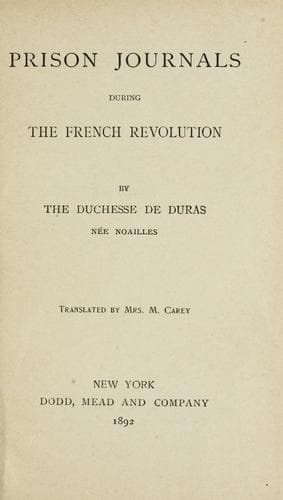
Prison Journals During the French RevolutionDuras, Louise Henriette Charlotte Philippine (de Noailles) de Durfort, duchesse de
History
Prison Journals During the French Revolution
Duras, Louise Henriette Charlotte Philippine (de Noailles) de Durfort, duchesse de
France -- History -- Revolution, 1789-1799 -- Personal narratives
These pretended conspiracies multiplied in a frightful manner. After
that of the Luxembourg, one was invented at St. Lazare, and another at
Bicêtre. The victims collected at the last mentioned prison, as a
_dépôt_, were brought to ours, and kept there twenty-four hours. The
convoy was escorted by forty gendarmes, armed with guns. There were a
good many priests. These unfortunate beings were chained together by
twos and threes, like wild beasts; most of them held their breviaries
in their hands. All of them were put in the dungeon to sleep, and they
were taken away in a body the next day to the Conciergerie. It is even
doubted whether they were ever condemned before being beheaded. I
cannot explain the barbarous curiosity which incited us to go to the
windows to see these itinerant hearses come and go. I remarked one day
to some of my companions that under the old régime, we should have gone
a long way to avoid meeting a criminal who was going to be hanged, and
now we gazed upon every innocent victim. I think we grew somewhat
hardened from constant contact with those who were so. The famous
Osselin, author of all the decrees against the _émigrés_, was in the
party from Bicêtre; he had concealed a dagger under his coat with which
he wounded himself several times during the night he passed at the
Plessis. These wounds were dressed as well as was possible, and he was
carried to the tribunal on a litter. He was guillotined the next day.
The sight of this man's suffering, criminal though he was, inspired me
with horror beyond description. He was literally cut to pieces.
On the 22d of July it was rumoured in the prison that some of the
ladies of the house of Noailles had been condemned. I did not speak of
it to Madame de la Fayette, but tried in vain to learn the truth of the
report. A little while after, however, I read in a newspaper that
Madame la Maréchale de Noailles and Madame la Duchesse d'Ayen had been
guillotined. Nothing was said about my dear little sister-in-law.[6]
The difficulty of procuring news from outside was extremely great. The
servants of the Reign of Terror even trembled for themselves. When I
questioned them, they answered vaguely. I no longer doubted the truth
of this new calamity; but I wanted to be sure of it before announcing
it to Madame de la Fayette, whose fears I sought in vain to arouse, and
who was always hoping for the best. At last I paid a jailer to gain for
me the confirmation of what I feared.
It was a sorrow to me the whole time I was hiding it from my cousin,
and my spirit was crushed. I loved the Vicomtesse de Noailles as a
daughter and friend. She possessed every possible virtue and charm, and
was the member of my family whom I most loved and confided in.
Public-domain text, read in full here on John Shaqi.
Reviews
Reviews
No reviews yet
Be the first to share your thoughts on this work.
Join the Discussion
Join the discussion
Sign in to leave a comment or review.
Sign InorCreate an account