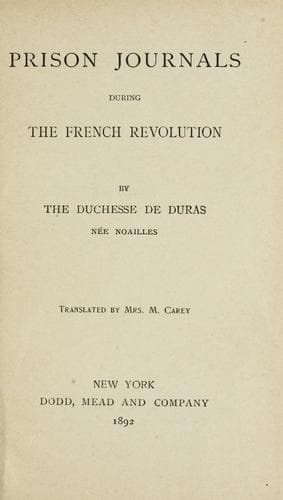
Prison Journals During the French RevolutionDuras, Louise Henriette Charlotte Philippine (de Noailles) de Durfort, duchesse de
History
Prison Journals During the French Revolution
Duras, Louise Henriette Charlotte Philippine (de Noailles) de Durfort, duchesse de
France -- History -- Revolution, 1789-1799 -- Personal narratives
I did not think it necessary to overwhelm my companions with the weight
of my griefs and fears. Some of them deluded themselves as certain sick
persons do during epidemics, though already attacked by the disease,
saying, 'He who just died had a hemorrhage; I have not. The other
complained of a pain in his back; I have not felt anything of the
sort.' Just so with the prisoners; they said to each other, 'Those who
were beheaded were in correspondence with the _émigrés_, they were
aristocrats, money was found on their persons,' etc. They tried to
persuade themselves that they were not in the category of those who
were every day being condemned. I looked at the situation in a
different light; it appeared to me impossible, if the Reign of Terror
continued, that any one of our class should escape. I felt sure I
should suffer the same fate as my parents; I sought to imitate their
resignation, and to honour their memory by dying in a manner worthy of
them. I thought that terrible armchair[7] had been honoured by the many
virtuous persons who had occupied it. Every evening when I went to bed
I repeated my _In manus_. I arranged for the distribution of all my
small supply of furniture among my companions. I constantly strove to
forgive injuries. My parents, who had been very admirable in this
respect, were my models. How beautiful, how Christian, how truly worthy
of emulation it is to feel no resentment against those who, after
having overwhelmed us with insult, conduct us to the tomb in a manner
so atrocious! It is only by following the teaching of the Gospel in
every respect that one can be enabled to practise a charity so perfect.
One more sacrifice remained for me to make,--the saddest of all: it
was, never to see my son again. I can never express what I felt then,
or what an effort it cost me to be resigned to it. I believed that God
would pardon me; and I was in as peaceful a state of mind as could be
expected under such cruel circumstances. I resolved that when I should
be called before the tribunal I would make no answer to the questions
of the iniquitous judges, but after hearing my sentence read, I would
say, 'You are condemning an innocent person; as a Christian I forgive
you, but the God of vengeance will judge you.'
I grieved to think that I was not to die for the faith. Ah! how
delightful, when one finds one's last hour approaching, to be able to
be sure of possessing a crown of glory and dwelling in that country of
which Saint Augustine says that 'Truth is the King, Charity the Law,
and the Duration, Eternity.' The idea that I was to die only because of
the ineradicable stain of aristocracy displeased me inexpressibly.
Public-domain text, read in full here on John Shaqi.
Reviews
Reviews
No reviews yet
Be the first to share your thoughts on this work.
Elsewhere in the archive
Join the Discussion
Join the discussion
Sign in to leave a comment or review.
Sign InorCreate an account