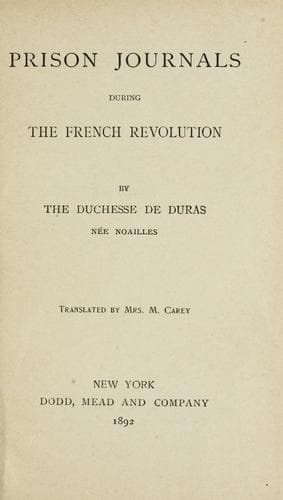
Prison Journals During the French RevolutionDuras, Louise Henriette Charlotte Philippine (de Noailles) de Durfort, duchesse de
History
Prison Journals During the French Revolution
Duras, Louise Henriette Charlotte Philippine (de Noailles) de Durfort, duchesse de
France -- History -- Revolution, 1789-1799 -- Personal narratives
On the 8th Thermidor, July 27th, 1794, we perceived toward evening an
extreme degree of the usual terrible watchfulness. The prisoners were
not allowed to go into the courtyard; the gratings were closed. One
would have been anxious under any circumstances; but when one is daily
expecting one's fate, one has no other fear. I had still, however, a
great dread of being killed by piecemeal, as was done on the 2d of
September, with pikes, bayonets, and such infernal weapons. I slept as
usual; and the next day, the 9th Thermidor, the sound of cannon was
heard. The keeper and jailer were in a state of great excitement; their
eyes looked haggard and their faces downcast. We knew nothing of what
was passing, but we presumed it must be something frightful. That
evening their countenances seemed more human, and there was a rumour of
the death of Robespierre.
The next day, the 10th, the inhabitants of houses adjoining the Plessis
made from their windows signs of satisfaction. Our keepers appeared
more serene. We heard cries of joy and clapping of hands in the
courtyard; a man named Lafond, who had been in close confinement for
five months, and of whose very existence we had been ignorant, had been
set at liberty. This was the dawn of less terrible days for us. We
believed for the first time that we might possibly be released from our
tomb. On the 11th, Madame Rovère's waiting-woman was set at liberty.
The moment a prisoner approached the grating, cries of 'Liberty'
resounded through the prison; and this word sounded very sweet to our
ears. I could not imagine what was going on outside. We learned that
the famous Terrorists continued to take the lead in the Convention,
that the terrible Collot d'Herbois, who had had us imprisoned, was one
of the number, which made me think that people of our class in society
would still be imprisoned. The thought of death never left me nor my
companions. Madame de Pons was very anxious to leave the Plessis; she
obtained permission to go to a private hospital. (The private hospitals
were the prisons where prisoners were best lodged and fed.) It was
proposed that I should send in the same petition; but I refused to do
so for two reasons: first, because I did not wish to act contrary to
the will of Providence, which had placed me in the Plessis; and second,
because it was very expensive living in the private hospitals.
Public-domain text, read in full here on John Shaqi.
Reviews
Reviews
No reviews yet
Be the first to share your thoughts on this work.
Elsewhere in the archive
Join the Discussion
Join the discussion
Sign in to leave a comment or review.
Sign InorCreate an account