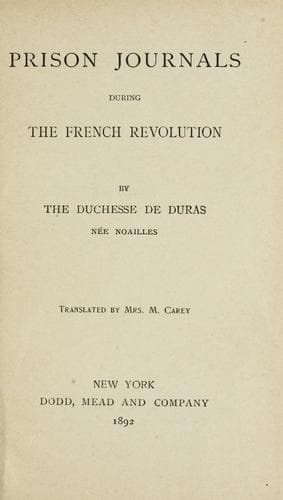
Prison Journals During the French RevolutionDuras, Louise Henriette Charlotte Philippine (de Noailles) de Durfort, duchesse de
History
Prison Journals During the French Revolution
Duras, Louise Henriette Charlotte Philippine (de Noailles) de Durfort, duchesse de
France -- History -- Revolution, 1789-1799 -- Personal narratives
Letters circulated more freely; and we could send them out by the
prisoners, who were leaving every day. I commissioned the governess of
Madame de Chauvelin's children to carry tidings of me to my
mother-in-law. We had learned that deputies had been sent into all the
prisons to release the prisoners, and that Bourdon, of the Oise, and
Legendre had charge of ours.
On the 16th of October, 1794, the great gate opened, and we saw the
carriage of these deputies enter,--which seemed a strange and pleasant
sight, since hitherto whenever a vehicle entered the courtyard it
departed loaded with victims. The deputies ascended to the clerk's
office, where the prisoners of the lower class were called up. Eighty
of them were at once set at liberty. The nobles were still ignorant
whether or not they would soon be numbered among the elect. The
deputies adjourned their second sitting to October 18. I felt that this
would probably be the day on which we would be subjected to our
examinations, and I dreaded it on account of my love of the truth. I
feared that I might be unfaithful to it, or that if I spoke the truth
plainly I might remain several years more in captivity. As I was
turning these thoughts over in my mind, which was very much troubled
(it was the famous 18th of October), I received orders to present
myself at the clerk's office. As we entered the room where the deputies
were, they said to us in a severe tone: 'Let the _ci-devants_ leave the
room; it is not proper to examine the good _sans-culottes_ in their
presence.' We retired and waited almost three hours, most of the time
standing. I conversed all this time with Madame de la Fayette. At last
my turn came. Bourdon asked me my names; I told them to him. He jumped
up out of his chair and exclaimed, 'These are terrible names! We cannot
set this woman at liberty; her case must be carried before the
Committee of General Security.'
I silently implored the aid of Heaven to enable me to watch over myself
at this moment and not to violate the truth.
Bourdon asked me several insignificant questions with regard to my
abode, the time of my imprisonment, etc. Legendre, whom Fortin and
Monsieur Noël had interested in my behalf, assumed a kindly manner, and
pointed out to his colleague that 'my papers were good, that I had been
spoken well of to him, that he knew that I had been a member of the
charitable board of St. Sulpice.' I felt a real satisfaction in being
under obligations to the poor. Fortin asked me what I had done to aid
the Revolution. I replied, 'All my life I have done any kind act that I
could; and I gave money to poor volunteers on my father's estate when
they set out for the army.' A prisoner who was present at my
examination had the kindness to bestow a panegyric upon me which the
keeper approved and added to, praising my submission to the rules of
the house.
Public-domain text, read in full here on John Shaqi.
Reviews
Reviews
No reviews yet
Be the first to share your thoughts on this work.
Elsewhere in the archive
Join the Discussion
Join the discussion
Sign in to leave a comment or review.
Sign InorCreate an account