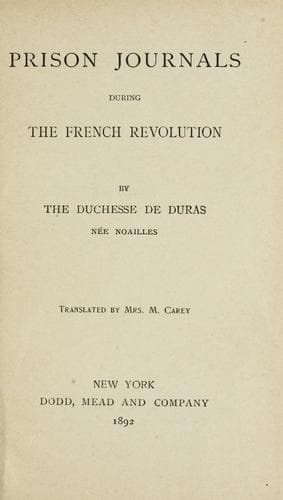
Prison Journals During the French RevolutionDuras, Louise Henriette Charlotte Philippine (de Noailles) de Durfort, duchesse de
History
Prison Journals During the French Revolution
Duras, Louise Henriette Charlotte Philippine (de Noailles) de Durfort, duchesse de
France -- History -- Revolution, 1789-1799 -- Personal narratives
I shall never forget this great kindness.
Madame de Grimaldi, her mother's sister, who was with us the day she
set out for the tribunal, saw Mademoiselle de Pons as she was getting
into Fouquier's wagon; she pressed her hand as she bade her good-by,
and said, 'I am content; my troubles will soon be over.'
Monsieur Noël inquired for me at the clerk's office; and I was very
glad to be able to show my gratitude to him for the proofs of affection
he had shown my parents. He proposed to make application for me to be
set at liberty. I refused to allow him to do so, urging as my objection
that I had read in one of the newspapers a denunciation against
Lecointre, of Versailles, issued by the Convention on account of his
having secured the release of Madame d'Adhémar from La Bourbe (the
convent of Port-Royal, on the Rue de la Bourbe, had been converted into
a prison under the appropriate name of Port-Libre), which made me fear
to compromise those who took an interest in me and our class generally;
and I determined to wait patiently a while longer. Next, the entire
convoy from Neuilly was set at liberty amid the cheers of the
prisoners. The nobles were not excluded from this measure,--a fact
which made me really believe, for the first time, that I should not
remain forever in the Plessis; and I wrote to Monsieur Noël that he
might bear me in mind. He had sent me tidings of all the members of my
family except my son, of whom I could learn nothing; the children of my
unfortunate sister-in-law came to see me.[8] Others were present; and I
could not utter a single word, so great was my emotion. I embraced them
and then retired to my chamber, completely overwhelmed by the
heart-rending memories awakened by their presence.
There was now great excitement among the prisoners. When one has no
hope, there is nothing to do but to be resigned; but we had laid aside
the thought of approaching death and had conceived the idea of being
released from captivity.
One day as I was sitting in my old room with the fireplace, which had
been vacated, and the possession of which once more was a real pleasure
to me, I saw a man come in from outside who was named Fortin; he told
me he was a lawyer frequently employed by Monsieur Legendre, a deputy
from Paris, and member of the Committee of General Security, and that
he could be of service to me. He asked me a great many questions, and
inspired me with confidence; he came to see me for several successive
days, and asked me for my papers. I showed him proofs that I had never
emigrated; that I had not gone outside of the Departments of Paris and
the Oise, from which I had certificates of civism and residence; that I
was imprisoned only as a noble, and that there was not the slightest
accusation against me. I afterward entered into correspondence with him.
Public-domain text, read in full here on John Shaqi.
Reviews
Reviews
No reviews yet
Be the first to share your thoughts on this work.
Elsewhere in the archive
Join the Discussion
Join the discussion
Sign in to leave a comment or review.
Sign InorCreate an account