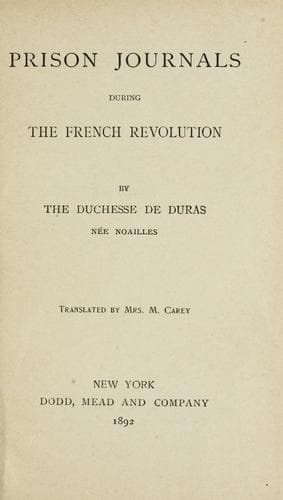
Prison Journals During the French RevolutionDuras, Louise Henriette Charlotte Philippine (de Noailles) de Durfort, duchesse de
History
Prison Journals During the French Revolution
Duras, Louise Henriette Charlotte Philippine (de Noailles) de Durfort, duchesse de
France -- History -- Revolution, 1789-1799 -- Personal narratives
I have always lived, and hope by the grace of God to die, in the Roman
Catholic Apostolic religion.
I forgive all my enemies (if I have any) from the bottom of my heart; I
pray that God may grant them his fullest pardon.
I request that payment may be made, etc.
Written at Paris, and
(Signed)
LOUISE NOAILLES.
I learned on leaving the prison that there was a certain lady named
Lavet who had been at the Conciergerie at the same time as Mesdames de
Noailles and d'Ayen. I hastened to go to see her and ask for an account
of their short and terrible residence in that prison, which she gave me
as follows:--
Mesdames de Noailles and d'Ayen arrived at the Conciergerie on the 21st
of July, 1793, excessively fatigued by their removal from the
Luxembourg, which had been made in very rough wagons. They were
suffering for want of food, which it was impossible to procure for
them, as it was nine o'clock at night, and the rules of the prison did
not permit anything to be brought in after nightfall. We could only
give them some gooseberry water to quench their thirst. They were put
into a dungeon where there were three other women, one of whom knew
Madame de la Fayette by reputation. She took a kind interest in her
neighbours, and undertook to help them to procure beds; but the
turnkeys having discovered that they had not so much as forty-five
francs,--which sum they exacted for furnishing them,--absolutely
refused to supply them. They had been robbed of everything at the
Luxembourg; the Vicomtesse de Noailles possessed only fifty sous.
Madame Lavet, touched by the situation of this unfortunate family, gave
her bed to Madame la Maréchale de Noailles, obtained one for Madame
d'Ayen, and proposed to her daughter that she should lie down on a cot.
She would not do so, however, saying that she had now too little time
to live to make it worth while to take the trouble. Madame d'Ayen spent
a greater part of the night trying to persuade her to do so, but could
not succeed. The angelic woman borrowed a book of devotions and a
light, by means of which she read and prayed to God constantly. She
stopped only long enough to wait upon her grandmother, who slept at
intervals for several hours. Every time she awakened the grandmother
read over her indictment, saying to herself: 'No, it is not possible
that I am to die on account of a conspiracy of which I know nothing; I
will plead my cause before the judges so that they shall not be able to
condemn me.' She thought of her dress, feared it was rumpled, arranged
her bonnet, and would not believe it possible that the next day could
be the last of her life. Madame d'Ayen had fears, but no conviction of
the imminent danger which threatened her. She dozed for a while. She
was greatly worried, wishing to send her watch--the only thing she had
left--to her children. She urged her companions to take charge of it;
Public-domain text, read in full here on John Shaqi.
Reviews
Reviews
No reviews yet
Be the first to share your thoughts on this work.
Elsewhere in the archive
Join the Discussion
Join the discussion
Sign in to leave a comment or review.
Sign InorCreate an account