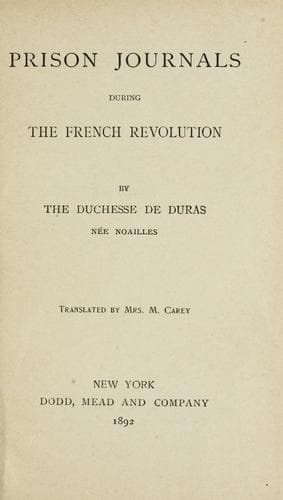
Prison Journals During the French RevolutionDuras, Louise Henriette Charlotte Philippine (de Noailles) de Durfort, duchesse de
History
Prison Journals During the French Revolution
Duras, Louise Henriette Charlotte Philippine (de Noailles) de Durfort, duchesse de
France -- History -- Revolution, 1789-1799 -- Personal narratives
We went almost joyfully to the Luxembourg. (Great God, how little one
can tell what one may be glad to do.) Our conductor left us in the
keeper's room. We remained there from five o'clock till nine. A
terrible scene took place in that apartment; the famous Henriot,
general of the Parisian army, came with his flute to look for a patriot
who had been unjustly incarcerated at Caen, and afterward brought to
Paris. He had taken a great deal of wine at a great dinner, where the
guests made terrible jokes about the aristocrats, saying, with coarse
laughter, 'Yes, we must have twenty thousand of those creatures'
heads.' We had to wait until they were gone before we could know where
we were to be lodged. The room assigned us was one formerly occupied by
Brissot de Varville. The window was still walled up. Madame de
Mouchy's, bed was set directly over the place where formerly stood the
bed of her mother (Madame d'Arpajon had an apartment at the Luxembourg,
being maid-of-honour to the Queen of Spain, Madame d'Orleans), who was
lodging there at the time of Madame de Mouchy's birth. She frequently
told us of having been born in the Luxembourg, of having been married
there, and would add, 'and do you not think it strange that I should be
imprisoned here?'
Although I did not really believe in the fate which actually threatened
her, this speech made me shiver inwardly. The day after our arrival was
spent entirely in getting ourselves settled to the best advantage in
the small space allotted to us.
The day after, the commissioner Bétremieux came to take Monsieur and
Madame de Mouchy to their house, so as to break the seals in their
presence. They had the pleasure of meeting there Mesdames de Poix, and
de Noailles. All passed off very well; nothing of a suspicious
character was found. The _procès-verbal_ was properly made out, and we
had some hopes that they would be allowed to remain in their own house;
but we returned that evening to the Luxembourg.
There were fifty-three persons there who were well known to them, as
they came from the section about the fountain of Grenelle. An order was
sent to transfer the women to the Anglaises; those of them who were
married obtained permission to remain.
Public-domain text, read in full here on John Shaqi.
Reviews
Reviews
No reviews yet
Be the first to share your thoughts on this work.
Elsewhere in the archive
Join the Discussion
Join the discussion
Sign in to leave a comment or review.
Sign InorCreate an account