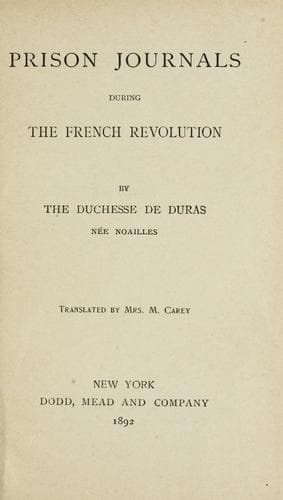
Prison Journals During the French RevolutionDuras, Louise Henriette Charlotte Philippine (de Noailles) de Durfort, duchesse de
History
Prison Journals During the French Revolution
Duras, Louise Henriette Charlotte Philippine (de Noailles) de Durfort, duchesse de
France -- History -- Revolution, 1789-1799 -- Personal narratives
gone out the day before to get some water and had not returned.
At last I obtained permission to go to see Mesdames de Noailles; the
distinguished Vicomtesse had made the beds, washed the dishes, and in
spite of all was in fine spirits. She joked about her labours, which
were quite extensive, and the more so since the deafness of the three
ladies caused them frequently to misunderstand one another. At night
she tied one end of a string to her arm and the other to her
grandmother's bed so that the latter might waken her if she needed her
during the night. She dressed her, attended to an abscess she had, and
also to one of her mother's. She had scarcely time to breathe, and her
zeal stood her instead of natural strength. I had, as I have said,
obtained permission to go and wait upon her. I had plenty to do, for I
rendered the same services to Monsieur and Madame de Boisgelin.
Our turn to be searched came at last on the fourth day, at eleven
o'clock in the morning. The sentinels had been withdrawn the day
before, at ten o'clock at night. Monsieur de Baquencourt, who lodged in
our quarter, took advantage of the first opportunity to come and tell
us that the search was terrible, that a prisoner had assured him that
he had been entirely stripped, that he had at first concealed his
_assignats_, but had afterward shown them as he preferred to give up
everything rather than to get into trouble. The idea of being stripped
and searched worried us very much; but there was no getting out of it.
All took place as he foretold; the municipal authorities and the guards
made the search. When they came to the _assignats_ I said, 'Citizens,
are you not going to count them?' One of them answered scornfully, 'We
need not count them in order to conquer the enemies of the Republic.'
'I am sure of that,' I replied; 'for they could not be conquered with
paper.' Madame de Mouchy, made a sign to me to be silent. Eight or ten
days after, the committee ordered the account of each prisoner to be
made out over again. This was done in the keeper's apartment. Then we
went back to the same old life. We tried to get accustomed to doing
without scissors and knives, but it was very inconvenient; and what was
still more disagreeable, the turnkeys, who formerly could receive money
for small services rendered, were forbidden to do so any longer, and
this made them very cross. The establishment of a public table was also
spoken of, which greatly distressed Madame de Mouchy. Soon after this a
commission was appointed to examine the prisoners; a good many of them
were anxious for it. The day it was announced loud cries of 'Vive la
Republique!' were heard in the galleries. It did not take place,
however, till two months afterward. One day about that time I was
sitting at work when some one called for me. I found at the door the
jailer (no longer the good Benoît) with two turnkeys, who asked me:
'What are you doing here?'
Public-domain text, read in full here on John Shaqi.
Reviews
Reviews
No reviews yet
Be the first to share your thoughts on this work.
Elsewhere in the archive
Join the Discussion
Join the discussion
Sign in to leave a comment or review.
Sign InorCreate an account