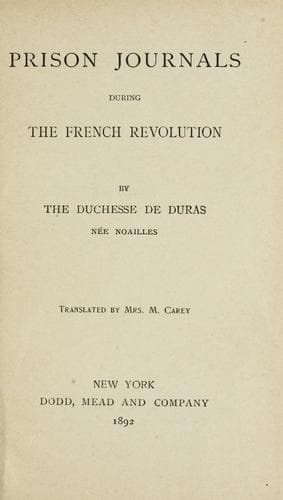
Prison Journals During the French RevolutionDuras, Louise Henriette Charlotte Philippine (de Noailles) de Durfort, duchesse de
History
Prison Journals During the French Revolution
Duras, Louise Henriette Charlotte Philippine (de Noailles) de Durfort, duchesse de
France -- History -- Revolution, 1789-1799 -- Personal narratives
I experienced a feeling of delight at being liberated contrary to my
expectation; but this sweet content was only momentary. I thought of
Mesdames de Noailles, whom I had left as it were in the ante-chamber of
death. I could think of nothing else; at least they would not suffer
the pain of seeing me share their fate on the morrow, and of thinking
that their children were left without any one to care for them.
'Religion will come to their aid,' I thought; 'but what a struggle they
will have to go through.' I gave thanks to God, and implored him to
come to their help in this moment so full of horror to human creatures;
and still praying as I went, I reached the Hôtel Mouchy. It was eleven
o'clock. The children had not gone to bed; they were waiting for me.
They asked me a great many questions, and told me that they had been
very much frightened when I did not return. I told them that I had had
a great many things to attend to which had caused me most unwillingly
to delay; that I had been very much occupied; that I could not tell
them then all that had happened to me because it was too late, but that
I would tell them all about it the next day. We then said our prayers
together and went to bed. 'At least,' said I to myself, 'they shall
pass this night in peace; the next will be cruel and bitter enough.'
The next day (the 22d of July), while the children were still asleep, I
went very early to the Rue des Sts. Pères, to see Père Brun, to tell
him that the Mesdames de Noailles were at the Conciergerie to be tried,
and would very probably be condemned to death that very day, and to beg
him to keep the promise he had made me, which was to try to meet them
as they passed from the prison to the extreme end of the Faubourg St.
Antoine, as this was the only consolation they could now have in this
world. He promised me he would not fail to be there. Whenever he could,
this good priest exercised this act of charity toward the victims. He
would accompany them, praying as he went, to the foot of the scaffold,
and there give them the last absolution. After the deed was done he
would return to his house, still praying, but with an aching heart.
Father Brun was a father of the Oratory. We had lived together at
Juilly, where we had charge of the Pensioners called _Minimes_, because
they were the youngest and the smallest. He was for a short time the
curate of the parish of Juilly. Madame la Vicomtesse de Noailles, whose
children, Alexis and Alfred, were in our hall, had corresponded with
him for almost a year. She had great confidence in him, and he deserved
it on account of his piety and his tender care of her children.
I returned to the Hôtel Mouchy. It was almost six o'clock. I awakened
the children, and told them that we were going to see their sister
Euphémie at St. Mandé, which pleased them very much. They never
suspected the terrible tidings I had to tell them till we came to the
end of our walk.[13]
-----
Footnote 13:
Public-domain text, read in full here on John Shaqi.
Reviews
Reviews
No reviews yet
Be the first to share your thoughts on this work.
Elsewhere in the archive
Join the Discussion
Join the discussion
Sign in to leave a comment or review.
Sign InorCreate an account