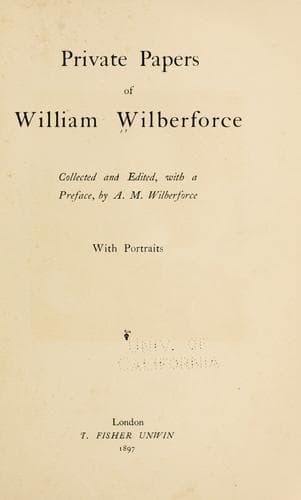
Private Papers of William WilberforceWilberforce, William
History
Private Papers of William Wilberforce
Wilberforce, William
Wilberforce, William, 1759-1833
"I have deemed it quite a duty on this delicious day to prolong my
country walk in a _tête-à-tête_ with your dear mother, a _tête-à-tête_,
however, from which our dear children's images are not excluded. I
own that those who are termed Methodists by the world do give more
liberally to the distressed than others, yet that I think they do
not in this duty come up to the full demands of Scripture. The great
mistake that prevails as I conceive is, it's being thought right that
all persons who are received on the footing of gentlemen are to live
alike. And without economy there cannot be sufficient liberality. I can
sincerely declare that my wish that my sons should be economical, which
is quite consistent with being generous, nay, as I said before, is even
necessary to it, arises far more from my conviction of the effects of
economical habits on their minds and happiness in future life, than on
account of the money that will be thereby saved. You have heard me, I
doubt not, praise Paley's excellent remark on the degree in which a
right constitution of the habits tends to produce happiness, and you
may proceed with the train of ideas I have called up in your mind."
"_October 26, 1825._
"You ask me about your Uncle Stephen's having been a newspaper
reporter. He was. The case was this. At the age of, I believe,
eighteen, he came up to town to study the law, when the sudden death of
his father not only stopped his supplies, but threw on his hands the
junior branches of the family, more especially three or four sisters.
Seeing no other resource, he embraced an offer, made to him I believe
through or by Mr. Richardson, the friend of poor Sheridan. Richardson
afterwards came into Parliament, and the fact respecting Stephen came
out thus, a few years ago. A regulation was proposed by some of the
benchers of Lincoln's Inn that no one should be permitted to be called
to the Bar who ever had practised the reporting art. Sheridan brought
the question forward in the House of Commons. Stephen, who was then in
Parliament, spoke to the question, and in arguing against the illiberal
and even cruel severity of the regulation, put a supposed case, that
the son of a gentleman, by a father's sudden death was at once deprived
of the means of pursuing the legal profession on which he was just
entering, being also harassed in his mind by the distressed state of
some affectionate sisters. Thus embarrassed, he received an offer of
employment as a reporter, and gladly accepted it and discharged its
duties, thereby being enabled to prosecute his professional studies
as well as to assist his relatives. 'But,' added Stephen, 'the case
I have just stated is no imaginary one. It is the story of a living
individual. It is that, sir, of the individual who has now the honour
to address you.' There is in all bodies of Englishmen a generous
feeling which is always called forth powerfully when a man confesses,
or rather boldly avows any circumstance respecting himself which,
Public-domain text, read in full here on John Shaqi.
Reviews
Reviews
No reviews yet
Be the first to share your thoughts on this work.
Elsewhere in the archive
Join the Discussion
Join the discussion
Sign in to leave a comment or review.
Sign InorCreate an account