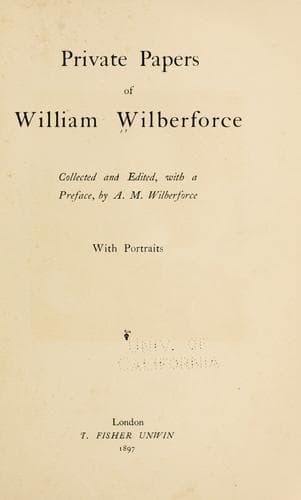
Private Papers of William WilberforceWilberforce, William
History
Private Papers of William Wilberforce
Wilberforce, William
Wilberforce, William, 1759-1833
"DEAR SIR,--I heard that you were anxious to get some paper on the
Slave Trade translated into Italian. An Italian gentleman who is upon
a visit to me will, I am sure, very willingly undertake it, and is
well qualified for the task, as he writes his language with great
elegance and understands ours. I am afraid you will not find his
Holiness as much disposed to anathematise rapine and murder committed
under the sanction of the powerful Crown of Spain, as to disdain the
extravagances of the Catholicks in Ireland. There was no difficulty
in abolishing the French Slave Trade last year but in the breasts of
the Bourbons and their adherents. Bonaparte by doing it at once lost
no adherents either in France or in the colonies, and the repugnance
felt in 1814 to the measure _at Court_ originated from their persuasion
that the principles of all Abolitionists, as well as of all toleration
in religion, are more or less connected with notions of political
liberty which they know to be incompatible with their system of
Government. True French Royalists, and many English Royalists too, make
no difference between you and me or between me and Tom Paine. We are
all equally heretics in Religion and Jacobins in Politics. There is
therefore nothing to be done with that class of men in the great cause
of Abolition, but by fear. We have already lost many opportunities, and
if we do not now insist on Portugal and Spain abandoning the trade, and
on France and the other powers treating it as piracy if they do not, we
shall have shifted the ignominy from ourselves, but we shall not have
rescued the world from the evil. May I ask if you understand why the
complete abolition in France (if that measure of Bonaparte be really
and in proper form confirmed) does not make part of the treaty? It
seems to me that at Paris, at Madrid, and at Rio Janeiro the cause has
been very coldly, or at least very inefficiently, supported, if it has
not been actually betrayed. When Ferdinand VII. wanted money we might
have imposed conditions on this and on other subjects, but we gave the
money first, and he now sets us at defiance. With many apologies for
the length of my letter,
"I am, sir, yours truly,
"VASSALL HOLLAND."
Early in 1825, William Wilberforce's brilliant Parliamentary career
came to an end by his own voluntary retirement. The Speaker's[39]
letter is the expression of a very general feeling both in the House
and outside it.
_The Right Hon. Speaker of the House of
Commons to Mr. Wilberforce._
"PALACE YARD,
"_February 19, 1825_
Public-domain text, read in full here on John Shaqi.
Reviews
Reviews
No reviews yet
Be the first to share your thoughts on this work.
Elsewhere in the archive
Join the Discussion
Join the discussion
Sign in to leave a comment or review.
Sign InorCreate an account