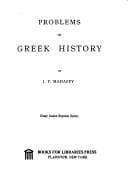
Problems in Greek historyMahaffy, J. P. (John Pentland)
History
Problems in Greek history
Mahaffy, J. P. (John Pentland)
Greece -- Historiography; Greece -- History
§ 65. There is, I think, a great tendency, whenever we come to estimate
a great and exceptional genius, to regard him as manifesting merely a
higher degree of that conscious ability called talent, or cleverness.
It is much easier to understand this view of genius than to give any
rational account of its spontaneity, its unconscious and unreflective
inspirations, which seem to anticipate, and solve without effort,
questions laboriously answered by the patient research or experiment of
ordinary minds[159:1]. We talk of 'flashes of genius.' When these
flashes come often enough, and affect large political questions, we have
results which baffle ordinary mortals, and are easily mistaken either
for random luck or acute calculation.
[Sidenote: Alexander's military antecedents.]
If I am right, Alexander started with few definite ideas beyond the
desire of great military conquests. On this point his views were
probably quite clear, and no doubt often reasoned out with his early
companions. He had seen the later campaigns of Philip, and had
discovered at Chæronea what the shock of heavy cavalry would do against
the best infantry the Greek world could produce. In his very first
operations to put down revolt and secure his crown, he had made trial of
his field artillery, and of the marching powers of his army through the
difficult Thracian country. He therefore required no Aristotle to tell
him that with the combined arms of Greece and Macedonia he could conquer
the Persian Empire. His reckless exposure of his life at the Granicus
and at Issus may indeed be interpreted as the divine confidence of a
genius in his star, but seems to me nothing more than a manifest defect
in his generalship, counterbalanced to some extent by the enthusiasm it
aroused in his household troops.
[Sidenote: He learns to respect Persian valour and loyalty.]
But it also taught him a very important lesson. He had probably quite
underrated the high qualities of the Persian nobles. Their splendid
bravery and unshaken loyalty to their king in all the battles of the
campaign, their evident dignity and liberty under a legitimate sovran,
must have shown him that these were indeed subjects worth having, and
destined to be some day of great importance in checking Greek discontent
or Macedonian insubordination. The fierce and stubborn resistance of the
great Aryan barons of Sogdiana, which cost him more time and loss than
all his previous conquests, must have confirmed this opinion, and led to
that recognition of the Persians in his empire which was so deeply
resented by his Western subjects.
[Sidenote: He discovers how to fuse the nations in Alexandria.]
Public-domain text, read in full here on John Shaqi.
Reviews
Reviews
No reviews yet
Be the first to share your thoughts on this work.
Elsewhere in the archive
Join the Discussion
Join the discussion
Sign in to leave a comment or review.
Sign InorCreate an account