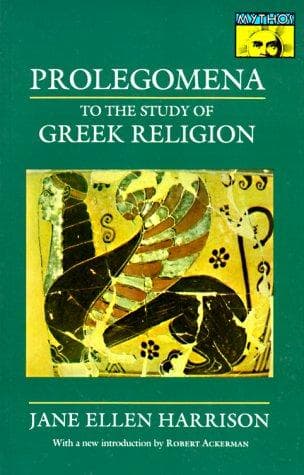
Tantalos, denied that he ever took it, Merope and Kleothera were snatched
away by the Harpies and given to the Erinyes.’
In the light of this version the vase-painting is clear. The moment
chosen is the coming of Hermes to claim the dog. It is no use Pandareos
denying he had it, for there it is, larger than life. The vase-painter
had to put the dog in, to make the story manifest. The two women
spectators are the daughters of Pandareos, Merope and Kleothera. Who is
the winged figure? Archaeologists variously name her Iris, a Harpy, an
Erinys. Iris I unhesitatingly reject. Between a Harpy and an Erinys the
choice is harder, and the doubt is instructive. Taking into consideration
the Lycian character of the story, and the not unimportant fact that the
design of the reverse represents a Lycian myth also, Bellerophon and
the Chimaera, I think we may safely say that the figure is a Harpy,
but it is a Harpy performing the functions of an Erinys, avenging the
theft, avenging the broken oath, come also to fetch the two maidens whom
she will give to be handmaids to the hateful Erinyes—so near akin, so
fluctuating are the two conceptions.
* * * * *
The fact then that Aeschylus brought them on the stage and his finer
poetical conception of horror compelled the complete and human
formulation of the Erinyes; before his time they have no definite
art-type. The Erinyes of Aeschylus are near akin to Gorgons, but
they lack the Gorgon mask; nearer still to Harpies, but wingless.
It is curious and interesting to note that at the close of the
_Choephori_[589], where they do not appear on the stage, where they are
visible only to the imagination of the mad Orestes, he sees them like the
shapes he knows—
‘These are like Gorgon shapes
Black-robed, with tangled tentacles entwined
Of frequent snakes.’
[Illustration: FIG. 49.]
Aeschylus felt the imaginative gain of the purely human form, but his
fellow artist the vase-painter will not lightly forego the joy of drawing
great curved wings. In vases that are immediately post-Aeschylean the
wingless type tends to prevail, though not wholly; later it lapses and
the great fantastic wings reappear. On the red-figured vase-painting[590]
in fig. 49—the earliest of the series and dating somewhere towards the
end of the 5th century—we have the scene of the purification of Orestes.
He is seated close to the omphalos—sword in hand. Above his head Apollo
holds the pig of purification, in his left hand the laurel; to the right
is Artemis as huntress with spears; to the left are the sleeping wingless
Erinyes; the ghost of Clytaemnestra beckons to them to wake. From the
ground rises another Erinys, a veritable earth demon. The euphemism of
the vase-painter makes the Erinyes not only wingless but beautiful, as
fair to see as Clytaemnestra.
[Illustration: FIG. 50.]
Public-domain text, read in full here on John Shaqi.
Reviews
Reviews
No reviews yet
Be the first to share your thoughts on this work.
Elsewhere in the archive
Join the Discussion
Join the discussion
Sign in to leave a comment or review.
Sign InorCreate an account