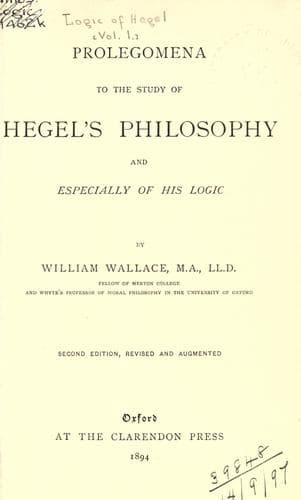
Prolegomena to the Study of Hegel's Philosophy, and Especially of His LogicWallace, William
Philosophy
Prolegomena to the Study of Hegel's Philosophy, and Especially of His Logic
Wallace, William
Hegel, Georg Wilhelm Friedrich, 1770-1831; Logic
In Nature, as in Mind, the most typical phenomenon is an original
heterogeneity, duplicity, or difference, which, however, points
back to a still more fundamental homogeneity, unity, or identity.
This primary unity or ground of unification does not indeed appear
to sight; the 'soul of Nature,' the _anima mundi,_ nowhere presents
itself as such in its undivided simplicity; but only as the perpetually
recurring re-union of what has been divided. But though unapparent,
the absolute identity is the necessary presupposition of all life
and existence, as of all knowledge and action. It is the link or
'copula' which perpetually reduces the antithesis to unity, and the
heterogeneity to homogeneity, and the different to redintegration. To
this fact of antithesis, presupposing and continually reverting to an
original unity, Schelling gives the name 'Polarity,' 'It is impossible
to construe the main physical phenomena without such a conflict of
opposite principles. But this conflict only exists at the instant
of the phenomenon itself. Each natural force _awakes_ its opposite.
But that force has no independent existence: it only exists in this
contest, and it is only this contest which gives it for the moment a
separate existence. As soon as this contest ceases, the force vanishes,
by retreating into the sphere of homogeneous forces[2].' Polarity,
therefore, is a general law of the cosmos.
A ceaseless, limitless activity, therefore, as the basis or groundwork
of all, for ever crossing, arresting, and limiting itself: an eternal
war, which, however, is always being led back to peace,--a process
of differentiation which rests upon, is the product of, and is for
ever forced back to integration, is the perpetual rhythm of the
natural universe. It is a process in which can be traced three grades,
stages, or 'powers' (first, second, and third, &c.). By its more
generally descriptive name it is called Organisation. 'Organism,'
says Schelling, 'is the principle of things. It is not a property
of single natural objects; but, on the contrary, single natural
objects are so many limitations, or single modes of apprehending the
universal organism[3].' 'The world is an organisation; and a universal
organism itself is the condition (and to that extent the positive)
of mechanism[4].' 'Mechanism is to be explained from organism: not
organism from mechanism.' 'The _essential_ of all things is _life_: the
_accidental_ is only the _kind_ of their life: and even the dead in
Nature is not utterly dead,--it is only extinct life.'
Public-domain text, read in full here on John Shaqi.
Reviews
Reviews
No reviews yet
Be the first to share your thoughts on this work.
Elsewhere in the archive
Join the Discussion
Join the discussion
Sign in to leave a comment or review.
Sign InorCreate an account