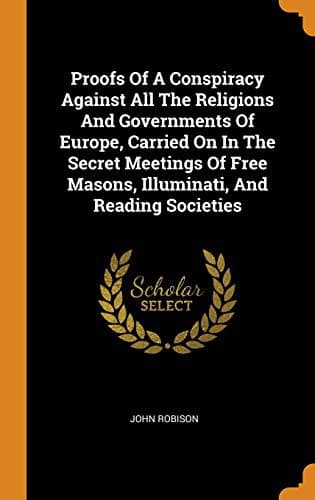
Proofs of a Conspiracy against all the Religions and Governments of Europe: carried on in the secret meetings of Free Masons, Illuminati, and reading societies.Robison, John
History
Proofs of a Conspiracy against all the Religions and Governments of Europe: carried on in the secret meetings of Free Masons, Illuminati, and reading societies.
Robison, John
Freemasonry -- Early works to 1800; Illuminati -- Early works to 1800
But this is too chimerical to be thought their real aim. Their
Founder, I dare say, never entertained such hopes, nor troubled
himself with the fate of distant lands. But it comes in his way when
he puts on the mask of humanity and benevolence: it must embrace
all mankind, only because it must be stronger than patriotism and
loyalty, which stand in his way. Observe that Weishaupt took a name
expressive of his principles. Spartacus was a gladiator, who headed
an insurrection of Roman slaves, and for three years kept the city
in terror. Weishaupt says in one of his letters, "I never was fond
of empty titles; but surely that man has a childish soul who would
not as readily chuse the name of Spartacus as that of Octavius
Augustus." The names which he gives to several of his gang express
their differences of sentiments. Philo, Lucian, and others, are very
significantly given to Knigge, Nicholai, &c. He was vain of the
name Spartacus, because he considered himself as employed somewhat
in the same way, leading slaves to freedom. Princes and Priests are
mentioned by him on all occasions in terms of abhorrence.
Spartacus employs powerful means. The style of the Jesuits, (as he
says,) he considers every mean as consecrated by the end for which
it is employed, and he says with great truth,
"_Flectere si nequeo superos, Acheronta movebo._"
To save his reputation, he scruples not to murder his innocent
child, and the woman whom he had held in his arms with emotions of
fondness and affection. But lest this should appear too selfish
a motive, he says, "Had I fallen, my precious Order would have
fallen with me; the Order which is to bless mankind. I should not
again have been able to speak of virtue so as to make any lasting
impression. My example might have ruined many young men." This he
thinks will excuse, nay sanctify any thing. "My letters are my
greatest vindication." He employs the Christian Religion, which he
thinks a falsehood, and which he is afterwards to explode, as the
mean for inviting Christians of every denomination, and gradually
cajoling them, by clearing up their Christian doubts in succession,
till he lands them in Deism; or if he finds them unfit, and too
religious, he gives them a _Sta bene_, and then laughs at the fears,
or perhaps madness, in which he leaves them. Having got them the
length of Deism, they are declared to be fit, and he receives them
into the higher mysteries. But lest they should still shrink back,
dazzled by the Pandemonian glare of Illumination which will now
burst upon them, he exacts from them, for the first time, a bond
of perseverance. But, as Philo says, there is little chance of
tergiversation. The life and honour of most of the candidates are
by this time in his hand. They have been long occupied in the vile
and corrupting office of spies on all around them, and they are
found fit for their present honours, because they have discharged
this office to his satisfaction, by the reports which they have
Public-domain text, read in full here on John Shaqi.
Reviews
Reviews
No reviews yet
Be the first to share your thoughts on this work.
Elsewhere in the archive
Join the Discussion
Join the discussion
Sign in to leave a comment or review.
Sign InorCreate an account