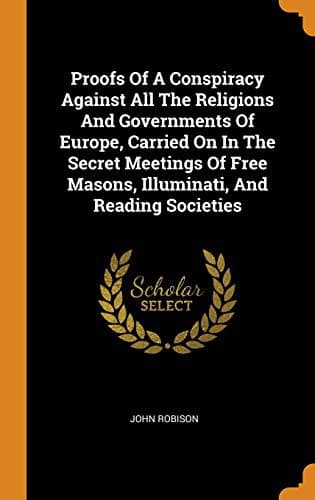
Proofs of a Conspiracy against all the Religions and Governments of Europe: carried on in the secret meetings of Free Masons, Illuminati, and reading societies.Robison, John
History
Proofs of a Conspiracy against all the Religions and Governments of Europe: carried on in the secret meetings of Free Masons, Illuminati, and reading societies.
Robison, John
Freemasonry -- Early works to 1800; Illuminati -- Early works to 1800
But before this, Nicholai had made to himself a most formidable
enemy. The history of this contest is curious in itself, and
gives us a very instructive picture of the machinations of that
_conjuration des philosophes_, or gang of scribblers who were
leagued against the peace of the world. The reader will therefore
find it to our purpose. On the authority of a lady in Courland,
a Countess von der Recke, Nicholai had accused Dr. Stark of
Darmstadt (who made such a figure in Free Masonry) of Jesuitism,
and of having even submitted to the _tonsure_. Stark was a most
restless spirit--had gone through every mystery in Germany,
Illuminatism excepted, and had ferreted out many of Nicholai's
hidden transactions. He was also an unwearied book-maker, and dealt
out these discoveries by degrees, keeping the eye of the public
continually upon Nicholai. He had suspected his Illumination for
some time past, and when the secret came out, by Spartacus' letter,
where he boasts of his acquisition, calling Nicholai a most sturdy
combatant, and saying that he was _contentissimus_, Stark left no
stone unturned till he discovered that Nicholai had been initiated
in all the horrid and most profligate mysteries of Illuminatism, and
that Spartacus had at the very first entrusted him with his most
darling secrets, and advised with him on many occasions[12].
[12] Of this we have complete proof in the private correspondence.
Philo, speaking in one of his letters of the gradual change which
was to be produced in the minds of their pupils from Christianity to
Deism, says, "Nicholai informs me, that even the pious Zollikofer
has now been convinced that it would be proper to set up a deistical
church in Berlin." It is in vain that Nicholai says that his
knowledge of the Order was only of what Weishaupt had published; for
Philo says that that corrected system had not been introduced into
it when he quitted it in 1784. But Nicholai deserves no credit--he
is one of the most scandalous examples of the operation of the
principles of Weishaupt. He procured admission into the Lodges
of Free Masons and Rosycrucians, merely to act the dishonourable
part of a spy, and he betrayed their secrets as far as he could.
In the appendix to the 7th volume of his journey, he declaims
against the Templar Masons, Rosycrucians, and Jesuits, for their
blind submission to unknown superiors, for their superstitions,
their priesthoods, and their base principles--and yet had been five
years in a society in which all these were carried to the greatest
height. He remains true to the Illuminati alone, because they had
the same object in view with himself and his atheistical associates,
His defence of Protestantism is all a cheat; and perhaps he may be
considered as an enemy equally formidable with Weishaupt himself.
This is the reason why he occupies so many of these pages.
Public-domain text, read in full here on John Shaqi.
Reviews
Reviews
No reviews yet
Be the first to share your thoughts on this work.
Elsewhere in the archive
Join the Discussion
Join the discussion
Sign in to leave a comment or review.
Sign InorCreate an account