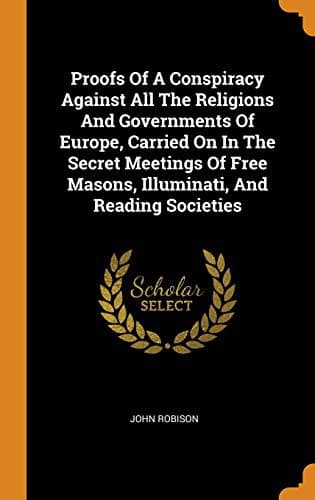
Proofs of a Conspiracy against all the Religions and Governments of Europe: carried on in the secret meetings of Free Masons, Illuminati, and reading societies.Robison, John
History
Proofs of a Conspiracy against all the Religions and Governments of Europe: carried on in the secret meetings of Free Masons, Illuminati, and reading societies.
Robison, John
Freemasonry -- Early works to 1800; Illuminati -- Early works to 1800
To such a degree had the Illuminati carried this favourite and
important point that they obtained the direction even of those
whose office it was to prevent it. There is at Vienna, as at
Berlin, an office for examining and licensing writings before
they can have their course in the market. This office publishes
annually an index of forbidden books. In this index are included
the account of the last _Operations of Spartacus and Philo in the
Order of Illuminati_, and a dissertation on _The Final Overthrow of
Free Masonry_, a most excellent performance, showing the gradual
corruption and final perversion of that society to a seminary of
sedition. Also the Vienna _Magazine of Literature and Arts_, which
contains many accounts of the interferences of the Illuminati in the
disturbances of Europe. The Censor who occasioned this prohibition
was an _Illuminatus_ named _Retzer_. He makes a most pitiful and
Jesuitical defence, showing himself completely versant in all
the chicane of the _Illuminati_, and devoted to their Infidel
principles. (See _Rel. Begebenh._ 1795, p. 493.)
There are two performances which give us much information respecting
the state of moral and political opinions in Germany about this
time. One of them is called, _Proofs of a hidden Combination to
destroy the Freedom of Thought and Writing in Germany_. These
proofs are general, taken from many concurring circumstances in the
condition of German literature. They are convincing to a thinking
mind, but are too abstracted to be very impressive on ordinary
readers. The other is the _Appeal to my Country_, which I mentioned
in page 84. This is much more striking, and in each branch of
literature, gives a progressive account of the changes of sentiment,
all supported by the evidence of the books themselves. The author
puts it past contradiction, that in every species of literary
composition into which it was possible, without palpable absurdity,
to introduce licentious and seditious principles, it was done. Many
romances, novels, journeys through Germany and other countries[18],
are written on purpose to attach praise or reproach to certain
sentiments, characters, and pieces of conduct. The Prince, the
nobleman, is made despotic, oppressive, unfeeling or ridiculous--the
poor, and the man of talents, are unfortunate and neglected--and
here and there a fictitious Graff or Baron is made a divinity,
by philanthropy expressed in romantic charity and kindness, or
ostentatious indifference for the little honours which are so
precious in the eyes of a German.--In short, the system of Weishaupt
and Knigge is carried into vigorous effect over all. In both these
performances, and indeed in a vast number of other pieces, I see
that the influence of Nicholai is much commented on, and considered
as having had the chief hand in all those innovations.
Public-domain text, read in full here on John Shaqi.
Reviews
Reviews
No reviews yet
Be the first to share your thoughts on this work.
Elsewhere in the archive
Join the Discussion
Join the discussion
Sign in to leave a comment or review.
Sign InorCreate an account