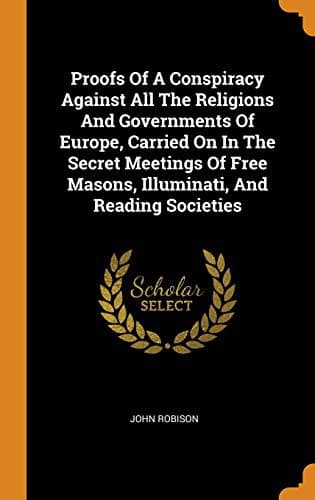
Proofs of a Conspiracy against all the Religions and Governments of Europe: carried on in the secret meetings of Free Masons, Illuminati, and reading societies.Robison, John
History
Proofs of a Conspiracy against all the Religions and Governments of Europe: carried on in the secret meetings of Free Masons, Illuminati, and reading societies.
Robison, John
Freemasonry -- Early works to 1800; Illuminati -- Early works to 1800
[19] Had the good man been spared but a few months, his surprise at
this neglect would have ceased. For, on the 19th of November 1793,
the Archbishop of Paris came to the Bar of the Assembly, accompanied
by his Vicar and eleven other Clergymen, who there renounced their
Christianity and their clerical vows; acknowledging that they
had played the villain for many years against their consciences,
teaching what they knew to be a lie, and were now resolved to be
honest men. The Vicar indeed had behaved like a true _Illuminatus_
some time before, by running off with another man's wife and his
strong box.--None of them, however, seem to have attained the higher
mysteries, for they were all guillotined not long after.
Mr. Lefranc says expressly, that this shocking perversion of Free
Masonry to seditious purposes was, in a great measure, but a late
thing, and was chiefly brought about by the agents of the Grand
Master, the Duke of Orleans. He was, however, of opinion that the
whole Masonic Fraternity was hostile to Christianity and to good
morals, and that it was the contrivance of the great schismatic
Faustus Socinus, who being terrified by the fate of Servetus, at
Geneva, fell on this method of promulgating his doctrines among
the great in secret. This opinion is but ill supported, and is
incompatible with many circumstances in Free Masonry--But it is out
of our way at present. Mr. Lefranc then takes particular notice
of the many degrees of Chivalry cultivated in the Lodges, and
shows how, by artful changes in the successive explanations of the
same symbols, the doctrines of Christianity, and of all revealed
religion, are completely exploded, and the _Philosophe Inconnu_
becomes at last a professed Atheist.--He then takes notice of the
political doctrines which are in like manner gradually unfolded,
by which "patriotism and loyalty to the prince are declared to be
narrow principles, inconsistent with universal benevolence, and with
the native and imprescriptible rights of man; civil subordination
is actual oppression, and Princes are _ex officio_ usurpers and
tyrants." These principles he fairly deduces from the Catechisms
of the _Chevalier du Soliel_, and of the _Philosophe Inconnu_. He
then proceeds to notice more particularly the intrigues of the
Duke of Orleans. From these it appears evident that his ambitious
views and hopes had been of long standing, and that it was entirely
by his support and encouragement that seditious doctrines were
permitted in the Lodges. Many noblemen and gentlemen were disgusted
and left these Lodges, and advantage was taken of their absence to
_improve_ the Lodges still more, that is to make them still more
anarchical and seditious. Numbers of paltry scribblers who haunted
the Palace Royal, were admitted into the Lodges, and there vented
their poisonous doctrines. The Duke turned his chief attention to
the French guards, introducing many of the privates and inferior
Public-domain text, read in full here on John Shaqi.
Reviews
Reviews
No reviews yet
Be the first to share your thoughts on this work.
Elsewhere in the archive
Join the Discussion
Join the discussion
Sign in to leave a comment or review.
Sign InorCreate an account