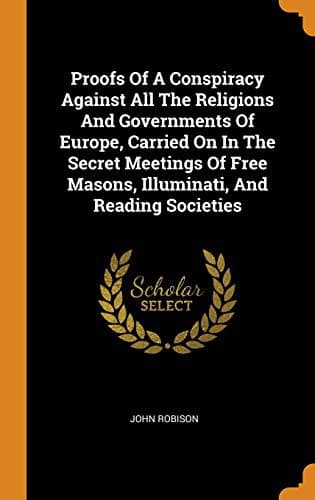
Proofs of a Conspiracy against all the Religions and Governments of Europe: carried on in the secret meetings of Free Masons, Illuminati, and reading societies.Robison, John
History
Proofs of a Conspiracy against all the Religions and Governments of Europe: carried on in the secret meetings of Free Masons, Illuminati, and reading societies.
Robison, John
Freemasonry -- Early works to 1800; Illuminati -- Early works to 1800
But I am in the wrong to adduce paternal or filial affection
in defence of patriotism and loyalty, since even those natural
instincts are reprobated by the _Illuminati_, as hostile to the
all-comprehending philanthropy. Mr. de la Metherie says, that
among the memorials sent from the clubs in England to the National
Assembly, he read two, (printed,) in which the Assembly was
requested to establish a community of wives, and to take children
from their parents and educate them for the nation. In full
compliance with this dictate of universal philanthropy, Weishaupt
would have murdered his own child and his concubine,--and Orleans
voted the death of his near relation.
Indeed, of all the consequences of Illumination, the most melancholy
is this revolution which it seems to operate in the heart of
man,--this forcible sacrifice of every affection of the heart to
an ideal divinity, a mere creature of the imagination.--It seems
a prodigy, yet it is a matter of experience, that the farther we
advance, or vainly suppose that we do advance, in the knowledge
of our mental powers, the more are our moral feelings flattened
and done away. I remember reading, long ago, a dissertation on
the nursing of infants by a French academician, Le Cointre of
Versailles. He indelicately supports his theories by the case of his
own son, a weak puny infant, whom his mother was obliged to keep
continually applied to her bosom, so that she rarely could get two
hours of sleep during the time of suckling him. Mr. Le Cointre says,
that she contracted for this infant "_une partialite toute-a-fait
deraisonable_."--Plato, or Socrates, or Cicero, would probably have
explained this by the habitual exercise of pity, a very endearing
emotion.--But our Academician, better illuminated, solves it by
stimuli on the _papillæ_ and on the nerves of the skin, and by the
meeting of the humifying _aura_, &c. and does not seem to think that
young Le Cointre was much indebted to his mother. It would amuse me
to learn that this was the wretch Le Cointre, Major of the National
Guards of Versailles, who countenanced and encouraged the shocking
treason and barbarity of those ruffians on the 5th and 6th of
October 1789. Complete freezing of the heart would (I think) be the
consequence of a theory which could perfectly explain the affections
by vibrations or crystallizations.--Nay, any very perfect theory of
moral sentiments must have something of this tendency.--Perhaps the
ancient systems of moral philosophy, which were chiefly searches
after the _summum bonum_, and systems of moral duties, tended more
to form and strengthen the heart, and produce a worthy man, than the
most perfect theory of modern times, which explains every phenomenon
by means of a nice anatomy of our affections.
Public-domain text, read in full here on John Shaqi.
Reviews
Reviews
No reviews yet
Be the first to share your thoughts on this work.
Elsewhere in the archive
Join the Discussion
Join the discussion
Sign in to leave a comment or review.
Sign InorCreate an account