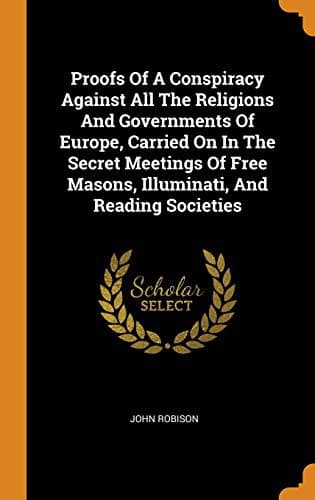
Proofs of a Conspiracy against all the Religions and Governments of Europe: carried on in the secret meetings of Free Masons, Illuminati, and reading societies.Robison, John
History
Proofs of a Conspiracy against all the Religions and Governments of Europe: carried on in the secret meetings of Free Masons, Illuminati, and reading societies.
Robison, John
Freemasonry -- Early works to 1800; Illuminati -- Early works to 1800
The Reader will now believe that I would not recommend the filling
the House of Commons with merchants, although they seem to be the
natural Representatives of the monied interest of the nation.
But I do not wish to consider that House as the Representative
of any Orders whatever, or to disturb its deliberations with any
debates on their jarring interests. The man of purely commercial
notions disclaims all generosity--recommends honesty because it
is the best policy--in short, "places the value of a thing in as
much money as 'twill bring." I should watch the conduct of such
men more narrowly than that of the Nobles. Indeed, the history of
Parliament will show that the Gentry have not been the most venal
part of the House. The Illumination which now dazzles the world aims
directly at multiplying the number of venal members, by filling
the senates of Europe with men who may be bought at a low price.
Ministerial corruption is the fruit of Liberty, and freedom dawned
in this nation in Queen Elizabeth's time, when her minister bribed
Wentworth.--A wise and free Legislation will endeavour to make
this as expensive and troublesome as possible, and therefore will
neither admit universal suffrage nor a very extensive eligibility.
These two circumstances, besides opening a wider door to corruption,
tend to destroy the very intention of all civil constitutions. The
great object in them is, to make a great number of people happy.
Some men place their chief enjoyment in measuring their strength
with others, and love to be continually employed in canvassing,
intriguing, and carrying on some little pieces of a sort of public
business; to such men universal suffrage and eligibility would be
paradise--but it is to be hoped that the number of such is not very
great: for this occupation must be accompanied by much disquiet
among their neighbours, much dissension, and mutual offence and
ill-will--and the peaceable, the indolent, the studious, and the
half of the nation, the women, will be great sufferers by all this.
In a nation possessing many of the comforts and pleasures of life,
the happiest government is that which will leave the greatest number
possible totally unoccupied with national affairs, and at full
liberty to enjoy all their domestic and social pleasures, and to do
this with security and permanency. Great limitations in the right of
electing seems therefore a circumstance necessary for this purpose;
and limitations are equally necessary on the eligibility. When the
offices of power and emolument are open to all, the scramble becomes
universal, and the nation is never at peace. The _road_ to a seat in
Parliament should be accessible to all; but it should be long, so
that many things, which all may in time obtain, shall be requisite
for qualifying the candidate. The road should also be such that
all should be induced to walk in it, in the prosecution of their
ordinary business; and their admission into public offices should
Public-domain text, read in full here on John Shaqi.
Reviews
Reviews
No reviews yet
Be the first to share your thoughts on this work.
Elsewhere in the archive
Join the Discussion
Join the discussion
Sign in to leave a comment or review.
Sign InorCreate an account