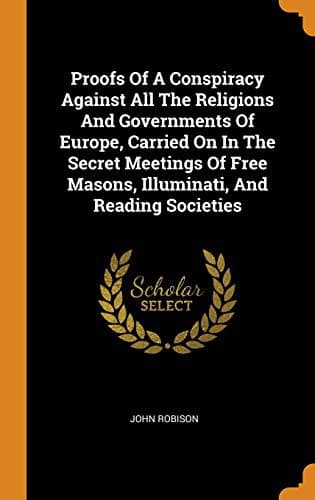
Proofs of a Conspiracy against all the Religions and Governments of Europe: carried on in the secret meetings of Free Masons, Illuminati, and reading societies.Robison, John
History
Proofs of a Conspiracy against all the Religions and Governments of Europe: carried on in the secret meetings of Free Masons, Illuminati, and reading societies.
Robison, John
Freemasonry -- Early works to 1800; Illuminati -- Early works to 1800
Of the zealous members of the Lodge Theodore the most conspicuous
was Dr. Adam Weishaupt, Professor of Canon Law in the University of
Ingolstadt. This person had been educated among the Jesuits; but the
abolition of their order made him change his views, and from being
their pupil, he became their most bitter enemy. He had acquired a
high reputation in his profession, and was attended not only by
those intended for the practice in the law-courts, but also by young
gentlemen at large in their course of general education; and he
brought numbers from the neighbouring states to this university, and
gave a _ton_ to the studies of the place. He embraced with great
keenness this opportunity of spreading the favorite doctrines of
the Lodge, and his auditory became the seminary of Cosmo-politism.
The engaging pictures of the possible felicity of a society where
every office is held by a man of talents and virtue, and where
every talent is set in a place fitted for its exertion, forcibly
catches the generous and unsuspecting minds of youth, and in a Roman
Catholic state, far advanced in the habits of gross superstition
(a character given to Bavaria by its neighbours) and abounding in
monks and idle dignitaries, the opportunities must be frequent
for observing the inconsiderate dominion of the clergy, and the
abject and indolent submission of the laity. Accordingly Professor
Weishaupt says, in his Apology for Illuminatism, that Deism,
Infidelity, and Atheism are more prevalent in Bavaria than in any
country he was acquainted with. Discourses, therefore, in which
the absurdity and horrors of superstition and spiritual tyranny
were strongly painted, could not fail of making a deep impression.
And during this state of the minds of the auditory the transition
to general infidelity and irreligion is so easy, and so inviting
to sanguine youth, prompted perhaps by a latent wish that the
restraints which religion imposes on the expectants of a future
state might be found, on enquiry, to be nothing but groundless
terrors, that I imagine it requires the most anxious care of the
public teacher to keep the minds of his audience impressed with
the reality and importance of the great truths of religion, while
he frees them from the shackles of blind and absurd superstition.
I fear that this celebrated instructor had none of this anxiety,
but was satisfied with his great success in the last part of this
task, the emancipation of his young hearers from the terrors of
superstition. I suppose also that this was the more agreeable to
him, as it procured him the triumph over the Jesuits, with whom he
had long struggled for the direction of the university.
Public-domain text, read in full here on John Shaqi.
Reviews
Reviews
No reviews yet
Be the first to share your thoughts on this work.
Join the Discussion
Join the discussion
Sign in to leave a comment or review.
Sign InorCreate an account