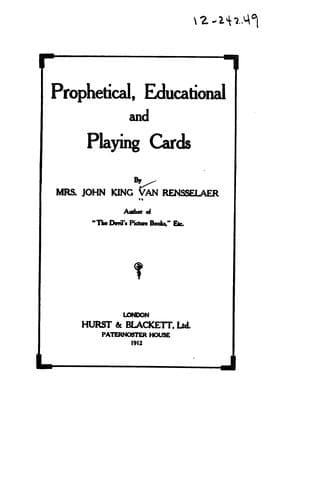
Prophetical, Educational and Playing CardsVan Rensselaer, John King, Mrs.
Religion
Prophetical, Educational and Playing Cards
Van Rensselaer, John King, Mrs.
Fortune-telling by cards -- History; Playing cards -- History
In France the backs of the cards are highly glazed and are of a plain,
uniform colour, generally red or green. In Spain card makers use speckled
backs. The modern Tarots have designs engraved on a very thin paper that
is pasted on the back, the edges of which are turned over the face of the
card, making a narrow border. These designs are sometimes "the woman of
Samaria," and at others a Hercules throwing rocks down a precipice. The
backs of old English cards were generally plain, and when paper was scarce
or expensive, old cards were too useful to be destroyed, and were used for
various purposes; hence we find them in the bindings of old books.
Sometimes they were cut up for paper dolls. The richly dressed figures of
the court cards were ingeniously put to this purpose, while a skillful
cutter could with a pair of scissors fashion sleds, chairs, tables, etc.,
from the pip cards.
In "Henry Esmond," Thackeray mentions that an invitation was sent on a Ten
of Diamonds, and this was a common practice in America before the
Revolution. There are several cards preserved in different families on
which invitations have been written or printed. One of them is as follows:
"Sir Jeffery Amhurst's compliments to Mrs. Paul Miller, and desires the
Favour of her Company to a Ball at the New Assembly Rooms on Saturday the
23d inst., being the Anniversary of St. George. Head Quarters April 18th,
1763, New York."
In the days of Charles I and the Commonwealth, there was a Sir John
Northcote, ancestor of the present peer, who took the Parliamentary side
against the king. His father was Justice Northcote, who at a game of cards
won an estate in Devonshire from a Mr. Dowrish. The game played was
Piquet, and to commemorate this transaction, the hands held by the players
were afterwards inlaid upon the table they used, that is still preserved
by the family.
CHAPTER XI
POINT CARDS WITH FRENCH PIPS
When Mercury's emblems were discarded by the French, some four hundred
years since, to be replaced by local designs, it was but natural that the
points should be accorded original and appropriate significances at their
birthplace, as well as in the alien countries where these new pips were
adopted. Names were suggested by the shape or usage of the device in
different games or under noteworthy occasions.
Thus, the Pique of the French (the shape of which was derived from the
outline of the _hallebarde_ of the soldiers who were on guard about their
king) received from the English the name of Spade, and for this several
derivations have been given. One of them is that the shape resembled that
of the shovel or spade common among miners, but the more probable origin
is the one that is suggested from the Tarot pip called by the Spaniards
Espadas, the name of which was transferred to the new emblem, which is a
suggestion that the Tarot cards were not unknown in England before the
arrival of the French pack, although no cards of this period have been
found in England.
Public-domain text, read in full here on John Shaqi.
Reviews
Reviews
No reviews yet
Be the first to share your thoughts on this work.
Elsewhere in the archive
Join the Discussion
Join the discussion
Sign in to leave a comment or review.
Sign InorCreate an account