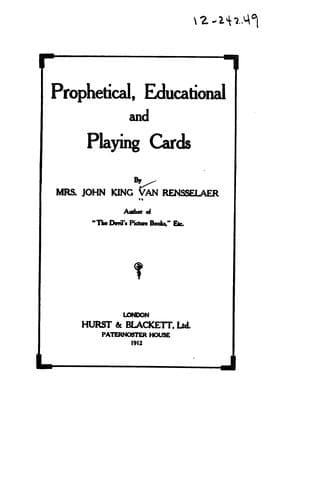
Prophetical, Educational and Playing CardsVan Rensselaer, John King, Mrs.
Religion
Prophetical, Educational and Playing Cards
Van Rensselaer, John King, Mrs.
Fortune-telling by cards -- History; Playing cards -- History
The first mention of Whist under the revised name is in "The Compleate
Gamester," which was published in 1674, and was intended to supply
standard rules for the fashionable games of the time. But Cotton's laws
were confusing, and the game was played in various ways in different parts
of England, since this standard was not universally accepted, and it is
said that Whist was a favourite only in the servants' hall, so that these
unarbitrary rules led to quarrels and sometimes even to bloodshed.
But when Edward Hoyle became interested in the game of Whist, he had for
partners or opponents some of the deepest players and most distinguished
men about town, and the gamesters gradually adopted regular rules for
their own guidance, which usually originated with Hoyle, so the fame of
his decisions about disputed points was noised abroad throughout London.
This led to his taking pupils at a guinea a lesson, and finally Hoyle
wrote out his rules for their benefit, distributing them first in
manuscript, but finally publishing them in "A Short Treatise on Whist,"
for which he received one thousand guineas. Hoyle's rules were adopted by
the clubs and players throughout England, so, when any dispute arose, his
book was consulted, and, instead of the players saying, "It is the wish
(or the voice) of the gods," as had been the original custom when
consulting the oracles of Mercury, and continued by card votaries, it
became customary to say, "It is according to Hoyle."
That gentleman lived until 1769, and his rules remained unaltered for over
one hundred years. In 1864, however, the Arlington and Portland Clubs,
finding that modifications were needed, revised the rules, after which the
"Cavendish rules" became the mode, but books on card rules are still
issued under the name of Hoyle's "Games of Cards," so "According to Hoyle"
is still a fashionable saying among the votaries of the card table.
CHAPTER XIII
ENGRAVED CARDS
Thanks to the lovers of woodcuts, prints, and engravings, the history of
European Playing Cards has been preserved. Through these it has been
investigated, as it would have been impossible in any other way, since the
men who are devoted to the card table are not usually of an investigating
turn of mind, while those who prophesy with cards prefer the occult and
mysterious to the scientific.
Public-domain text, read in full here on John Shaqi.
Reviews
Reviews
No reviews yet
Be the first to share your thoughts on this work.
Elsewhere in the archive
Join the Discussion
Join the discussion
Sign in to leave a comment or review.
Sign InorCreate an account