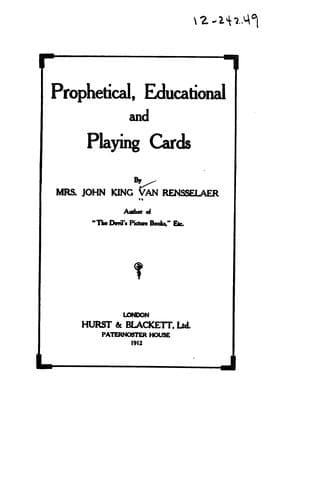
Prophetical, Educational and Playing CardsVan Rensselaer, John King, Mrs.
Religion
Prophetical, Educational and Playing Cards
Van Rensselaer, John King, Mrs.
Fortune-telling by cards -- History; Playing cards -- History
How well the good man succeeded in obliterating games of chance or hazard
may be questioned, since Nuremburg is still one of the chief centres of
card making, the descendants of the original makers being in active
business to-day, who sell sheets of cardboard that were concealed for many
years, on which the cards are printed, but not cut apart, for probably the
manufacture was checked at the time, but never entirely suppressed. The
celebrated museum of the town has one of the best collections of native
Playing Cards to be found, while the dramatic holocaust is recalled with
pride by the inhabitants, who value the woodcut that is commemorative of
the event.
English preachers denounced card playing, and the Scotch dubbed the packs
"The Devil's Picture Books." Robert Burns says:
The Ladies, arm in arm, in clusters,
As great and gracious a' as sisters,
* * * * *
On lee-lang nights, wi' crabbit leuks.
Pore owre the devil's pictured beuks.
The Sunday before Christmas, 1529, Bishop Latimer preached a sermon
against gambling at St. Edward's Church, in Cambridge, taking for his text
"Who art thou?" and filling his sermon with phrases that were culled from
Primero, which was the favourite game of his day. This knowledge showed
such an intimate acquaintance with the game that his offended hearers used
it with great effect against him. The sermon is now remembered only
because of these phrases and expressions that give students a clue to the
rules and play of the old game.
One ingenious preacher took for his text: "As God has dealt to every man"
(Romans xii:3), implying that the Almighty had sorted and distributed the
cards of life. This practical allusion to gambling so horrified his
congregation that they nearly pulled the minister from the pulpit. Yet
St. Paul evidently referred to the "tablets of fate," on which the
destinies of men were written at birth as "the measure of fate," since
these traditions must have been active in the mind of the apostle. Modern
people seldom place themselves in the atmosphere of Biblical times, which
leads to much misconstruction and misunderstanding.
The various proclamations and edicts passed against Playing Cards are a
history in themselves, although it is a pity that they are of too late a
date to throw much light on the first alteration of the cult of Mercury
into games, a change that was probably gradual, and so insidious or secret
as to have no public record. Still, it is through these legal papers that
we get authentic dates and the earliest mention of cards as gambling
instruments or toys; but at the end of the fourteenth century, at a time
when cards were denounced as such, and by name there is still no
interdiction of fortune-telling, which may have been conducted too
secretly to occasion attention, or, perhaps, the general law against
vagrants or gypsies may have been deemed sufficient protection.
Public-domain text, read in full here on John Shaqi.
Reviews
Reviews
No reviews yet
Be the first to share your thoughts on this work.
Elsewhere in the archive
Join the Discussion
Join the discussion
Sign in to leave a comment or review.
Sign InorCreate an account