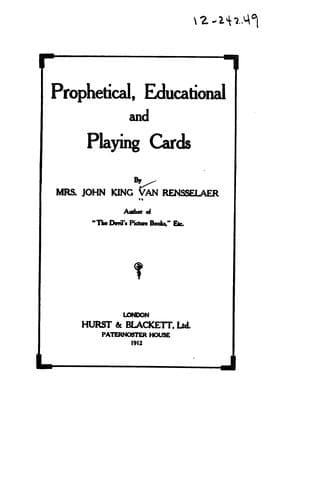
Prophetical, Educational and Playing CardsVan Rensselaer, John King, Mrs.
Religion
Prophetical, Educational and Playing Cards
Van Rensselaer, John King, Mrs.
Fortune-telling by cards -- History; Playing cards -- History
Games with dice are favourites in all Asiatic countries, but the men
themselves and the games played with them are far more elaborate and
scientific than those of Europe, and capable of a great variety of
combinations quite unknown to English-speaking nations. The mathematical
calculations necessary for the Asiatic games are intricate and
complicated, but well worthy of adoption.
About 1815 the Germans issued a pack of cards that had dice on them
instead of the commonplace pips. The set in the writer's collection is
incomplete and incomprehensible without the rules, that have been lost.
The cards have the dice on the lower half, while the upper part displays
different designs, such as a diligence, a ship, a bookcase, and an easy
chair. The two designs last mentioned have "doctor" printed under them.
[Illustration: GAMBLING, HISTORICAL AND EDUCATIONAL CARDS
95-96 Spanish Cards showing Four of Cups (with name Naypes, meaning
prophetical) and Knave of Money (with the gazelle of Osiris).
97 English Educational Cards--historical. One of the Jubilee pack
containing Queen Victoria and all her descendants.
98 Netherlands Domino Card for teaching music.
99 United States Domino Card.
100 United States Numbered Card for game of Grabouche or Flinch.
101 United States Educational Card for game of Authors.
102 English Educational Card for teaching arithmetic.]
Games of dice are probably the oldest known, and are found in all Asiatic
countries. The evolution from them to dominos is easily traced, for the
latter is evidently a pair of dice placed together. The pieces in a Korean
set of dominos in the writer's collection are of the size that a pair of
European dice would make if glued side by side. Besides the games of
chance, dice are used for divining purposes all over the world, but
particularly in Africa and Asia.
Jackstones, or Knuckle-bones, is another old game. There is in the British
Museum a most interesting marble group of boys playing Jackstones. A
lively dispute, if not an active fight, over the result of the game is in
progress, and the little men are scattered over the ground while the boys
wrestle.
Jackstones may be of many different materials, although those most
commonly used are the simple round pebbles found by any roadside. A set
in the writer's collection is of bone, which was common in New York about
1850. Others are of glass and are said to be Phoenician. Ivory and sheeps'
knuckles are favourites with children, who in modern times have added a
small rubber ball for a Jack.
Public-domain text, read in full here on John Shaqi.
Reviews
Reviews
No reviews yet
Be the first to share your thoughts on this work.
Elsewhere in the archive
Join the Discussion
Join the discussion
Sign in to leave a comment or review.
Sign InorCreate an account