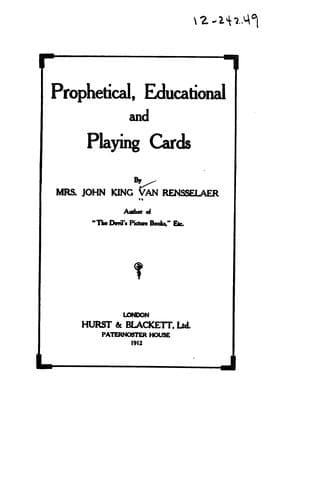
Prophetical, Educational and Playing CardsVan Rensselaer, John King, Mrs.
Religion
Prophetical, Educational and Playing Cards
Van Rensselaer, John King, Mrs.
Fortune-telling by cards -- History; Playing cards -- History
Let us now consider the other method of fortune-telling, which was
followed by Etteila, a celebrated French fortune-teller, who lived in
Paris about one hundred years since, who wielded a vast influence over his
compatriots, who firmly believed, as, indeed, he did himself, that he had
discovered the key to the Book of Thoth Hermes Trismegistus through an old
pack of Tarots that fell by chance into his hands.
It is said that Napoleon Bonaparte had great faith in the deductions and
revelations of this _ci-devant_ hairdresser's apprentice, to whom
Josephine presented him. The empress was an ignorant and credulous woman,
owing to her education in the West Indian island of her birth, the society
of which was corrupted by Negro superstitions of a most complicated and
far-reaching character.
Etteila published a book called "Collection sur les Hautes Sciences"
(1780). It included an essay on "The Sublime Book of Thoth" that is now
very rare, but he saw what few others had seen, that Playing Cards were of
Egyptian origin, although he failed entirely to trace their progress
through the temples of Nebo and Thoth to the Mercury of the Romans, so, of
course, never connected the pips with the emblems of Mercury or
discovered that they originated from the divine commands given to the
Israelites, as well as to the desire of primitive people to consult the
Tablets of Fate that were inscribed by Nebo, the great god of Babylonia.
Many of the statements and beliefs of Etteila would have doubtless been
received with greater credence if these tokens had been pointed out. But
Etteila declared that he had discovered the different subtle meanings
connected with the Tarots, and that he had elucidated many of the points
that had previously been obscure. He certainly obtained astonishing
results when consulting the Tarots, or a set of cards that were probably
invented by himself, and which are now rare. They were adorned with
figures of men and women dressed in the fashion of his day, with numbers
on them, but with no pip marks. They were printed on a yellow-tinted
paper, and when issued were accompanied by a small book of rules for their
use in divining.
Papus, in his "Tarots of the Bohemians," having digested various works on
the Gypsies, kabalism, and occultism, worked out many rules for divining
with the Tarots. He places great reliance on magnetic currents, the
position of the stars, and the signs of the zodiac, suggesting astrology,
but he finds these symbols in the Tarots. He also gives value to the
letters of the Hebrew alphabet in connection with the Atouts, but, after
all, he declares that intuition plays a most important part when reading
the Tarots.
Public-domain text, read in full here on John Shaqi.
Reviews
Reviews
No reviews yet
Be the first to share your thoughts on this work.
Elsewhere in the archive
Join the Discussion
Join the discussion
Sign in to leave a comment or review.
Sign InorCreate an account