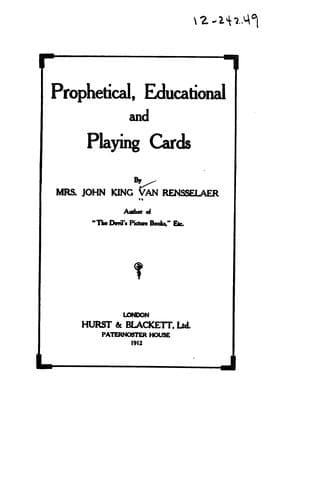
Prophetical, Educational and Playing CardsVan Rensselaer, John King, Mrs.
Religion
Prophetical, Educational and Playing Cards
Van Rensselaer, John King, Mrs.
Fortune-telling by cards -- History; Playing cards -- History
The above is a short and hurried method of consulting the cards, but
Etteila had a second one that was used when a whole career was to be
revealed, as well as the character, or the influence of education,
friends, and family. It also indicated the future position and chief
events of life. In short, it was supposed to be a repetition of the scene
when a young man, on reaching maturity made a solemn sacrifice in the
temple, when the "Tablets of Fate," that had been inscribed by Nebo,
Thoth, or Mercury at his birth, were consulted. In this way their wishes
were obtained that should govern his career in life. This ceremony was
never repeated, although the orders of the gods were often requested on
particular occasions without going through the entire performance or the
full consultation that had been made at maturity.
According to Papus, four deals are required for this process of
divination, but his methods are unnecessarily complicated, so they may be
simplified without altering the results.
Shuffle all the Tarots without making any distinction between the Atout
and the pip cards. Let the Inquirer cut them three times, and then cut
them in three packets of about equal size. Take the central heap, deal out
twenty-six cards, and lay them to the right in a pile. Shuffle those
remaining with the rest of the pack, and let them again be cut, and then
again cut into three piles. Select the centre and deal seventeen cards,
placing them in a pile beside the one containing the twenty-six cards.
Shuffle the stock again together, and let them be shuffled and cut as
before, taking again the centre packet and dealing eleven cards. Collect
the remaining twenty-four cards and put them aside. This is the Widow, or
Stock, and these cards represent the events that might have happened in
the life of the Inquirer, but were eliminated by luck or chance, and
these often prove most interesting.
The first packet, containing the twenty-six cards, represents the soul or
the character of the Inquirer, and of those most closely connected with
him. The pile containing the seventeen cards represents his mind or the
events controlling him. And the pile of eleven cards represents the body,
the ills or annoyances of life, or the events to take place, such as the
profession to be chosen, the journeys to be taken, with other happenings.
The cards should be spread out on a table, so that they can easily be seen
and interpreted according to their value, as given on pages 000-000, the
upper row containing the "soul" pile, the second row the "mind" pile, and
the third row containing the "body" pile.
"From this system," says Papus (page 330), "Etteila deduced his subtle
arguments upon the creation of the universe, the Kabbalah, and the
Philosopher's stone." If any person can emulate him in these deductions,
they must be "wise in their generation," and must have established direct
communication with the great god Nebo himself, the "writer of the Tablets
of Fate."
Public-domain text, read in full here on John Shaqi.
Reviews
Reviews
No reviews yet
Be the first to share your thoughts on this work.
Elsewhere in the archive
Join the Discussion
Join the discussion
Sign in to leave a comment or review.
Sign InorCreate an account