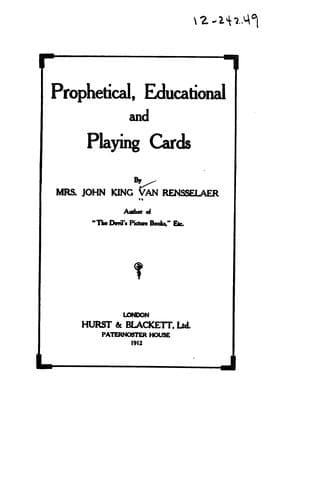
Prophetical, Educational and Playing CardsVan Rensselaer, John King, Mrs.
Religion
Prophetical, Educational and Playing Cards
Van Rensselaer, John King, Mrs.
Fortune-telling by cards -- History; Playing cards -- History
The Day of Judgment is the symbol of this Atout, and its letter is Resh,
representing typically the head of man. The picture shows an angel
blowing a trumpet from the clouds, while below, the earth is yawning, to
allow the dead to rise. This is a strange emblem to be placed among the
heathen leaves, for it is peculiarly Christian in its significances; but
even the oldest designs show it pictured in this way. As it stands, it
expresses motion, movement, travels, readjustments, originality,
determination, respiration, and regeneration. Then, also, it typifies
scenery, skill, and artistic capabilities. The Romans dedicated it to
Pluto, the ruler of the nether world. It has many of the attributes of
Ishtar, the goddess of the Babylonians, from whose name Easter is derived.
She represented spring, and was the protector of vegetation, growth, and
agriculture. The angel blowing the trumpet is a very old design, and one
often used on tombs or cenotaphs. It recalls Theodore Hook's witty epitaph
on Lord de Ros, of whom little good could be said, and who was accused of
cheating at cards, but whose family erected a fine monument to his memory,
on which was the representation of the angel of the Resurrection. Under it
Hook wrote: "Here _LIES_ England's Premier Baron patiently waiting the
last _trump_."
XXI. IL MONDO (The World)
This card shows the nude figure of a woman, in an ellipse of leaves and
flowers, the victor's wreath of the Grecians. She represents verity or
truth. In the four corners are the emblems of the apostles that St. John
borrowed from Ezekiel, and the latter from Assyria and Babylonia. These
are the Man, Lion, Bull and Eagle. Besides typifying the apostles, they,
in a manner, suggest the four attributes of the pip suits, and also the
four elements. The inscrutable-looking man represents brain, knowledge,
and mystery. The ox typifies strength, and the lion courage, while the
eagle suggests inspiration and the power of soaring above mundane affairs.
These four emblems represent also the four seasons, when the ox stands for
autumn, the man for winter, the lion for summer, and the eagle for spring;
so the complex meaning of the twenty-first Atout suggests that the head or
wisdom of man prescribes the will of the ox, the courage of the lion, and
the aspirations of the bird, through the mouth of Truth. The attributes of
the designs on the cards are also included in this leaf from the book of
Thoth. The wand that the figure holds represents the Stave, or caduceus,
or magic wand of Aaron, "that was kept for a token," as well as fire. The
Cup betokens the south, and summer, and water. The Sword, earth, and the
Coin (or Ring), eternity and air. Il Mondo's letter is Tau, which
symbolises perfection. The meaning of the whole card covers the elements
of success, luck, happiness, marriage, contentment, bliss.
XXII. IL MATTO (The Fool)
Public-domain text, read in full here on John Shaqi.
Reviews
Reviews
No reviews yet
Be the first to share your thoughts on this work.
Elsewhere in the archive
Join the Discussion
Join the discussion
Sign in to leave a comment or review.
Sign InorCreate an account