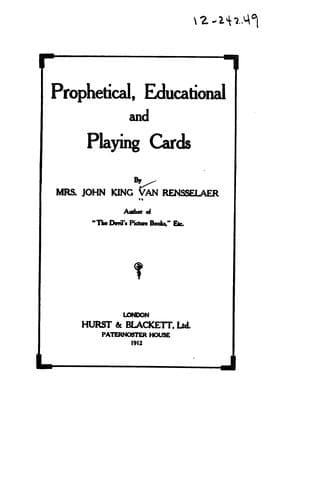
Prophetical, Educational and Playing CardsVan Rensselaer, John King, Mrs.
Religion
Prophetical, Educational and Playing Cards
Van Rensselaer, John King, Mrs.
Fortune-telling by cards -- History; Playing cards -- History
Count Emiliano di Parravicino, in his essay on Tarocco cards in the
_Burlington Magazine_ for December, 1903, declares that professional
players or teachers, known as _barrattieri_ or _rabildi_, were organized
in guilds that were recognised by law as early as the beginning of the
thirteenth century, which seems as if the deposed initiates, or the
priests of Mercury, were still vital and a recognised necessity, although
under a new title.
Happily for the card student, there still remain several packs of Italian
cards that link the present ones with the ancient emblems of Mercury. The
ducal family of Visconti inherited sixty-one cards that originally
belonged to Duke Filippo Maria Visconti, having been executed for him by
Marziano da Tortona early in the fifteenth century. These were mentioned
by Breitkopf in his work published at Leipsic in 1784. This pack differs
from its compatriots and successors in having five, instead of four, court
cards. The Atouts are beautifully painted with all the attributes
connected with Mercury. That of "the Lovers," No. VI, represents Duke
Filippo Maria wearing a broad-brimmed hat on which is inscribed "_A bon
Droit_"; the female figure is dressed as a bride and is probably a
likeness of the Duke's first wife, Beatrice di Tenda, the widow of
Francisco Cane. These figures are surrounded with small shields blazoning
the arms of Visconti and Pavia.
Among these Atouts No. XIII, Death, is represented on a black, instead of
on a white, horse. The figures on the other cards resemble those still
commonly used, but, unfortunately, there are fifteen cards missing from
the pack. This historic collection of Tarots has been frequently described
and reproduced, since Marziano da Tortona, who executed the pictures, was
a scholar, as well as a skillful artist. He introduced some original
features in his treatment of the pictures while strictly conforming to the
heraldic devices that marked their origin, for no man living at that time
would be ignorant enough to change the devices, since they still told
their story to the people of the day, who understood heraldry even if they
could not decipher written words.
This celebrated pack of cards was probably a wedding gift to the
illustrious couple, since the artist was also their secretary. That it was
prized, but little handled, and kept as a work of art is proved by the
good condition of the pictures, which are almost as fresh as when they
left the hands of the designer. They are treasured possessions of the
descendants of Duke Filippo Maria Visconti and are seldom allowed to be
seen or exhibited.
Public-domain text, read in full here on John Shaqi.
Reviews
Reviews
No reviews yet
Be the first to share your thoughts on this work.
Elsewhere in the archive
Join the Discussion
Join the discussion
Sign in to leave a comment or review.
Sign InorCreate an account