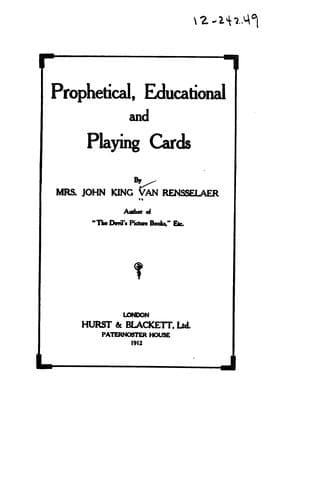
Prophetical, Educational and Playing CardsVan Rensselaer, John King, Mrs.
Religion
Prophetical, Educational and Playing Cards
Van Rensselaer, John King, Mrs.
Fortune-telling by cards -- History; Playing cards -- History
The "Jesse" pack of cards, now to be seen in Paris, are painted on
cardboard, and the figures are dressed in the fashions of the day. The
emblems recall the heraldic tokens of two of the courtiers of Charles VI,
as well as the one identified with one of the most beautiful and learned
women of her day. It is said that the invention of these pips was due to
the anxiety of Queen Isabella and her ministers to divert the unfortunate
monarch, so as to prevent his interfering with their schemes.
It was with the alteration of the pips, the adoption of _Coeurs_ (Hearts),
_Carreaux_ (Diamonds), _Trèfles_ (Clubs), and _Piques_ (Spades), the
distinctive use of red and black unmingled with other colours, and the
discarding of the fourth court card, together with the Joker, and the
Atout part of the old pack, that the fortune-telling Book of Thoth became
transformed into a set of toys or gambling instruments. It is little
wonder that their original intention, purpose, and history became
obliterated and finally almost forgotten, so that when a French writer
ventured to state that cards were part of the Egyptian mysteries he was
treated as a foolish dreamer.
The invention of the French pips is attributed to two persons, both of
them courtiers of the king, who probably worked together to produce a
simple and convenient set of devices that should be easily recognised and
as well adapted for playing, as were the original Tarots suited for
divining the lives and characteristics of mankind. One of the inventors
of the French pips was Etienne Vignolles, whose nickname was La Hire, and
this name has been found on some of the old cards, as if he wished to be
perpetuated in this way, and not as the brave old soldier who was well
versed in chivalric customs, and who, according to historians, had always
his sword drawn against the English. The second person to whom is credited
the invention of the Piquet pack is Etienne Chevalier, secretary to the
king, and his treasurer, who was noted for his original and inventive
genius and his quick wit. It is more than probable that to his facile
pencil the new designs should be attributed. The men who formulated the
rules of the game for which they invented the cards must have been clever,
as it is arranged with such care that these rules have remained
practically unaltered for five hundred years, and Piquet is still a
favourite in men's clubs and the best tête-a-tête game known.
Public-domain text, read in full here on John Shaqi.
Reviews
Reviews
No reviews yet
Be the first to share your thoughts on this work.
Elsewhere in the archive
Join the Discussion
Join the discussion
Sign in to leave a comment or review.
Sign InorCreate an account