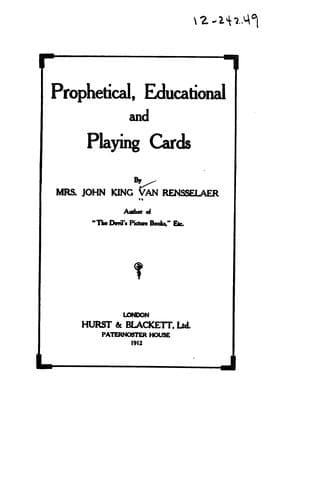
Prophetical, Educational and Playing CardsVan Rensselaer, John King, Mrs.
Religion
Prophetical, Educational and Playing Cards
Van Rensselaer, John King, Mrs.
Fortune-telling by cards -- History; Playing cards -- History
In the United States, a pack is incomplete without the Joker, which then
makes fifty-three cards to a standard pack. Many writers have tried to
connect the number fifty-two with the weeks of the year, but, as can
easily be seen by studying the Tarots, this was not the original number,
and the French, when inventing their new set of cards, probably had no
such connection in mind, and the Piquet, which is the earliest French
pack, contains less than fifty-two cards.
The Joker did not make its appearance in the United States until about the
middle of the nineteenth century, and then for a rather strange reason.
The cards used in the Northern States were those inherited from France or
England, while those used in the extreme South-western States were of
Spanish origin, but the packs of none of these countries had retained the
old figure of Mercury. The Joker, however, suddenly appeared in the
American packs, the reason for this being as follows, cards are printed or
stamped on large sheets of paper, which are afterwards cut apart to the
required size. When arranged on the sheet, one space in a corner was not
used, and, therefore, left blank, although the back was printed exactly
like all the rest of the pack. Having no need for this card, the makers
generously threw it in, and placed it on the outside of the wrapper, so as
to show the colour and design of the back. The value of the new card was
rapidly recognised by players, who, impelled by some unknown power,
assigned to it the position originally occupied by Il Matto of the Tarot
pack, with all its old privileges of taking every other card. It was
particularly valuable in the game of Euchre, that sprang into popularity
at the same time that the Joker (or the one who played tricks and took
them) was adopted. So, through this accidental appearance of a blank card
in the pack, Mercury suddenly asserted his old supremacy, and cunningly
resumed his wonted place and power in the card world, although his
original prominence and his cult had been entirely overlooked and
forgotten for over five hundred years, except in one particular town in
Italy, where the old Tarots are retained in their pristine condition.
Instead of using a blank card on the outside of the pack, some of the
European card manufacturers make a hole in the wrapper, through which may
be seen the Ace of Hearts, stamped with the government revenue stamp. In
England and the United States, the name of the manufacturer is printed on
the Ace of Spades, and the revenue stamp is pasted on the wrapper of the
pack. German card makers often place a blank card in their wrappers, but
it has not been incorporated into any of the local games, nor does it bear
a revenue stamp or the maker's name upon it.
Public-domain text, read in full here on John Shaqi.
Reviews
Reviews
No reviews yet
Be the first to share your thoughts on this work.
Elsewhere in the archive
Join the Discussion
Join the discussion
Sign in to leave a comment or review.
Sign InorCreate an account