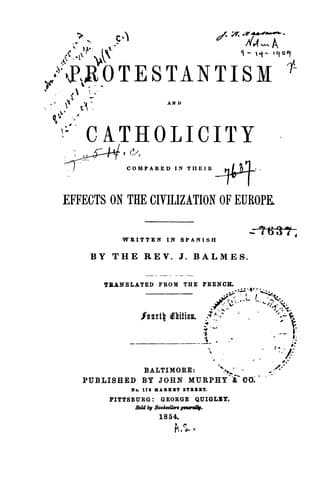
Protestantism and Catholicity compared in their effects on the civilization of EuropeBalmes, Jaime Luciano
Philosophy
Protestantism and Catholicity compared in their effects on the civilization of Europe
Balmes, Jaime Luciano
Catholic Church -- Apologetic works; Catholic Church -- Doctrines -- Catholic authors; Christian civilization; Europe -- Civilization; Protestantism
The principle of universal toleration is now proclaimed, and all kind
of intolerance is condemned without appeal. But who takes care to
examine the real meaning of these words? who undertakes to analyze
the ideas which they contain by the light of reason, and explain them
by means of history and experience? Very few. They are pronounced
mechanically; they are constantly employed to establish propositions of
the highest importance, without even the suspicion that they contain
ideas, the right or wrong comprehension and application of which is
every thing for the preservation of society. Few persons consider
that these words include questions as profound as they are delicate,
and the whole of a large portion of history; very few observe that,
according to one solution given to the problem of toleration, all the
past is condemned, and all the present overturned; nothing is left
thereby to build on for the future but a moving bed of sand. Certainly,
the most convenient way in such a case is, to adopt and employ these
words such as we already find them in circulation, in the same way as
we take and circulate the current coin, without considering whether
it be composed of alloy or not. But what is the most convenient is
not always the most useful; and, as when receiving coins of value,
we carefully examine them, so we ought to weigh words the meaning of
which is of such paramount importance. Toleration--what is the meaning
of this word? It means, properly speaking, the patience with which
we suffer a thing which we judge to be bad, but which we think it
desirable not to punish. Thus, some kinds of scandals are tolerated;
prostitutes are tolerated; such and such abuses are tolerated; so that
the idea of toleration is always accompanied by the idea of evil.
When toleration is exercised in the order of ideas, it always supposes
a misunderstanding, or error. No one will say that he tolerates the
truth. We have an observation to make here. The phrase _to tolerate
opinions_ is commonly used: now, opinion is very different from error.
At first sight, the difficulty appears great; but if we examine the
thing well, we shall be able to explain it. When we say that we
tolerate an opinion, we always mean an opinion contrary to our own. In
this case, the opinion of another is, according to us, an error; for
it is impossible to have an opinion on any point whatever--that is, to
think that a thing is or is not, is in one way or in another--without
thinking at the same time that those who judge otherwise are deceived.
If our opinion is only an opinion--that is, if our judgment, although
based on reasons which appear to us to be good, has not attained to a
degree of complete certainty--our judgment of another will be only a
mere opinion; but if our conviction has become completely established
and confirmed--that is, if it has attained to certainty--we shall be
sure that those who form a judgment opposed to ours are deceived.
Public-domain text, read in full here on John Shaqi.
Reviews
Reviews
No reviews yet
Be the first to share your thoughts on this work.
Elsewhere in the archive
Join the Discussion
Join the discussion
Sign in to leave a comment or review.
Sign InorCreate an account