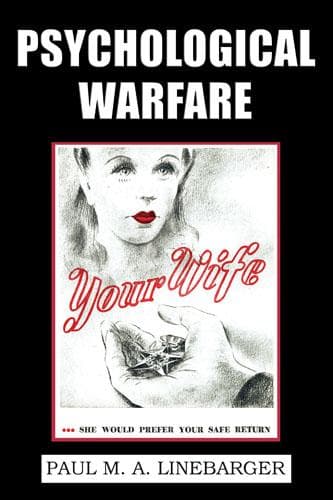
Psychological WarfareLinebarger, Paul Myron Anthony
History
Psychological Warfare
Linebarger, Paul Myron Anthony
Psychological warfare
But the job was done!
Success was not due to the formal structure of the Office of War
Information (see charts V, VI). No administrative formula could have
transcended such governmental confusion. It was owing to the fact that
all the people just described--who went around, with the best will in
the world most of the time, minding one another's business--did in the
end achieve effective results. The common denominator behind them was
not the authority of the President, the discipline of the Democratic
Party, or the casually designed, casually overlooked formal lines of
authority. The common denominator was American civilization itself. Had
we been deeply disunited, this ramshackle structure would have collapsed
into chaos. But there was broad concurrence, a sense of cooperativeness,
good will and good temper. A German, Russian or Japanese bureaucrat
would have gone mad in the wartime mazes of the Federal system; a
Chinese would probably have felt very much at home, but would have
polished up the titles and honorifics a little.
The difference between our governmental organization and that of our
enemies lay in the fact that to us the T/O were something that could be
used when convenient, and could (without breach of faith or law) be
short-circuited when convenient. Word was passed around, material
exchanged, coordination effected in ways which could not be shown on any
imaginable chart. It was neither a merit nor a defect, but simply an
American way of doing things.
This characteristic has the effect, however, of making after-the-fact
studies quite unrealistic. There is not much from the formal records and
the formal charts which conveys the actual tone of governmental
operations in terms of propaganda. Study of World War II organization
for the sake of research and planning against possible future war would
not be very profitable unless it delved into the concrete experience of
individuals. The formal outlines mean nothing; they are positively
deceptive unless the actual controls and operations are known. (Mr.
Warburg makes it plain in his book that he thinks little of Mr. Elmer
Davis' conception of his job; but he does not mention that Mr. Sherwood,
theoretically Mr. Davis' subordinate, ran foreign operations without
much reference to Mr. Davis or to any other part of the Federal
government. Since Mr. Sherwood was closer to the White House than was
Mr. Davis, this important consideration escapes being recorded on the
chart: foreign operations were actually autonomous.[35]) Examples of how
things really worked--as opposed to how they looked as though they
worked--could be multiplied forever; but the soundest way of finding out
sober, judicious opinion will necessarily await the writing of
autobiographies and memoirs by the people concerned.
Public-domain text, read in full here on John Shaqi.
Reviews
Reviews
No reviews yet
Be the first to share your thoughts on this work.
Elsewhere in the archive
Join the Discussion
Join the discussion
Sign in to leave a comment or review.
Sign InorCreate an account