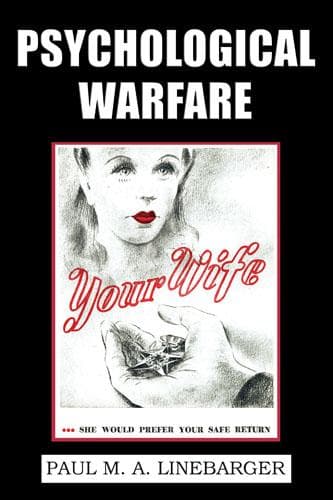
Psychological WarfareLinebarger, Paul Myron Anthony
History
Psychological Warfare
Linebarger, Paul Myron Anthony
Psychological warfare
(4) A series of phases, marking off the forms and methods of control
so that the controlling staff can plan for a first phase of doing its
own publishing and broadcasting, a second phase of letting the local
people work under license with close supervision and technical help,
and a third phase of permitting them freedom within the normal
censorship limits of military government. The American DISCC's
(District Information Services Control Commands) in the American Zone
of Germany did an excellent job in moving rapidly from phase one to
phase two in 1945 and 1946.
=Contingency Plans.= Frequently the chiefs of government and services
know of an operation or danger that may arise, which will change the
character of the war. Such were the North African landings, the Italian
surrender, D-day itself, the joining of the American and Russian forces
in Germany, Hitler's death. For such contingencies, it is desirable to
have plans ready stating the reaction of the government to the event.
Such plans can be prepared and distributed to select personnel, and
downgraded or released, together with any needed last-minute change,
when the first word comes through that the event is officially to be
recognized. Profoundly secret contingencies--such as Hiroshima day--do
not lend themselves to such treatment.
It must be repeated that plans are effective only when transposed into
plain, simple, usable guidances for the actual operatives. When a plan
is so secret or so involved that the only people who could carry it out
are not allowed to know anything about it, it becomes a sad
self-defeating effort.
CHAPTER 12
Operations for Civilians
Plainly, psychological warfare operates against civilians with as much
effect as it does against troops. Indeed, under the rather high
standards set for modern warfare by The Hague and Geneva conventions,
psychological warfare is left as one of the few completely legitimate
weapons which can on occasion be directed against an exclusively
civilian and noncombatant target. Even though World War II erased most
of the distinctions between military and civilian, leaving civilians in
the vertical front line of all air war, psychological warfare gained. It
became a more useful instrument for bettering war. Civilian interest in
propaganda became no mere matter of emotional loyalty or philosophical
preference, but a life-and-death matter to its recipients. After fire
raids it would be a madman who would disregard an enemy bomb-warning
leaflet without trying to figure out its application to himself and his
children.
Public-domain text, read in full here on John Shaqi.
Reviews
Reviews
No reviews yet
Be the first to share your thoughts on this work.
Elsewhere in the archive
Join the Discussion
Join the discussion
Sign in to leave a comment or review.
Sign InorCreate an account