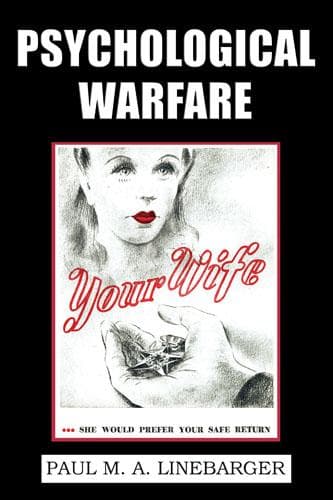
Psychological WarfareLinebarger, Paul Myron Anthony
History
Psychological Warfare
Linebarger, Paul Myron Anthony
Psychological warfare
(5) Appeals to women. (Women, statistically, are around 50% of the
population of any country. With the diversion of men to fighting
operations the percentage of women in the home population rises and in
wartime it may become 60% or 70%. They face social and economic
problems much more immediately than do men because the responsibility
for maintaining homes and children normally falls on them. Evidence
of humane intentions, of reluctance to wage the most cruel forms of
war, of attempts to help civilians escape unnecessary danger, can
bring women into the participating enemy group for relaying
propaganda.)
=Pamphlets.= Where air-dropping facilities are plentiful, leaflets can
be supplemented by pamphlets. Pamphlets have the advantage of giving the
propagandist more space for texts or pictures, enabling him to tackle
enemy arguments in detail or in depth. Pamphlets can present sustained
arguments, and thus come closer to meeting the domestic propaganda
facilities of the enemy on even ground. They are especially useful in
countering or neutralizing those enemy arguments which depend either on
formal argument or on misapplied statistics, and which therefore require
point-by-point confutation.
The pamphlet shown in figure 6 is an excellent example of the medium.
Though it carries a complex message, it can be read by persons at the
lowest educational level. It meets enemy propaganda over a whole range
of themes. It is apt to be disseminated farther, whether initial
distribution be by ground or by air.
Unlike the leaflet, the pamphlet is sometimes hard to conceal. For well
policed areas, it must be supplied with a protective disguise if it is
to be passed along. One ingenious pamphlet made up by Dennis McEvoy and
Don Brown at OWI for dropping on the Japanese, started out with a
warning: "_Enemy!_ Warning! This is an Enemy Publication, issued by the
United States Government. Finder is Commanded to take this to the
Nearest Police Station Immediately! _Enemy!_" The pamphlet gave a
general statement of Japan's bad war position, _and was addressed to
Japanese policemen and police officials_. The cover urged the policemen
not to keep the pamphlet, nor to destroy it, but to pass it on up
through channels to their superiors as an instance of enemy propaganda.
(We never found out what the Japanese police actually did when they got
these.)
One Japanese black leaflet assumed the proportions of a book, and was
made up in the familiar format of the pocket-sized twenty-five-cent
volumes. With a New York dateline, a copyright notice, and even a
printers' union label all neatly falsified, the book expressed
opposition to Roosevelt's war. It was circulated by the Japanese as a
captured enemy book, presumably, in order to convince their own people
and their Asiatic associates that opposition to World War II existed
within the United States itself.
Public-domain text, read in full here on John Shaqi.
Reviews
Reviews
No reviews yet
Be the first to share your thoughts on this work.
Elsewhere in the archive
Join the Discussion
Join the discussion
Sign in to leave a comment or review.
Sign InorCreate an account