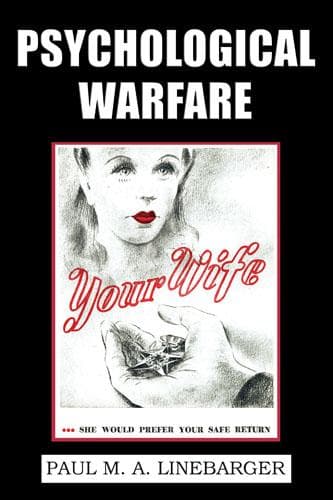
Psychological WarfareLinebarger, Paul Myron Anthony
History
Psychological Warfare
Linebarger, Paul Myron Anthony
Psychological warfare
If white propaganda is to be compared to incendiary bombing, in that it
ultimately affects the enemy armed services by disorganizing the
homeland behind them, black propaganda may be compared to the tinfoil
strips used in anti-radar. Black propaganda strikes directly at enemy
security. It gives him too much to do, and thus increases the chances
for agents down on the ground to succeed in their lonely, dangerous
work.
=Motion Pictures.= In consolidated areas, allied or neutral territory,
and the home jurisdiction, motion pictures for civilians can be employed
as a major propaganda instrument. The combination of visual and auditory
appeal ensures a concentration of attention not commanded by other
media. In both World Wars, the U.S. made extensive use of film.
Procurement can be either through direct governmental manufacture of the
finished product, or by subcontracting to nongovernmental agencies.
Propaganda films normally make a point of displaying the military
prowess and civic virtue of the distributor.
Officially distributed films are, however, almost always overshadowed by
pure entertainment films. The wartime official movie can penetrate no
deeper than can the unofficial picture. Financial and commercial
control, plus censorship, limits the periphery into which motion-picture
showings can be extended. Often the private film will be shown when a
public one would be suppressed. And in time of peace, the propaganda
movie has ever sharper competition from its private competitors. Few
propaganda movies have ever achieved the spectacular impact of some
private films in portraying the American way of life. Tahitians, Kansu
men, Hindus and Portuguese would probably agree unanimously in
preferring the USA of Laurel and Hardy to the USA of strong-faced men
building dams and teaching better chicken-raising.
Only rarely does the cinema penetrate enemy territory or reach
clandestine audiences. Its direct contribution to critical-zone
psychological warfare is therefore slight. Perhaps television may in
course of time combine attention-holding with transmissibility.
CHAPTER 13
Operations Against Troops
In every instance of systematic American use of psychological warfare
against enemy troops during World War II, affirmative results were
discerned after the operation had been in effect for a short while.
Figure 46 shows the consummation of the troop propaganda program; these
Germans are surrendering and they carry the Allied leaflets with them.
By the latter phases of the liberation of France, 90 per cent of the
enemy prisoners reported that they had seen or possessed Allied leaflets
and the most famous leaflet of them all, the celebrated _Passierschein_
(see figure 4) came to be as familiar to the Germans as their own paper
money.[41] Since every enemy who surrenders is one less man to root out
or destroy at a cost of life to one's own side, the sharp upswing of
enemy surrenders was a decided military gain.
Public-domain text, read in full here on John Shaqi.
Reviews
Reviews
No reviews yet
Be the first to share your thoughts on this work.
Elsewhere in the archive
Join the Discussion
Join the discussion
Sign in to leave a comment or review.
Sign InorCreate an account