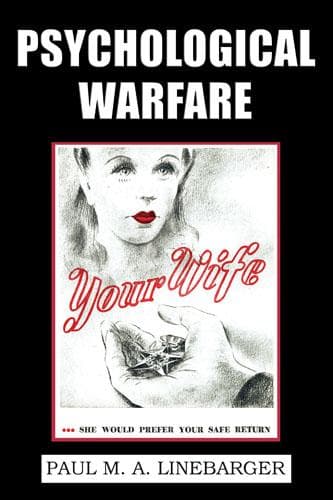
Psychological WarfareLinebarger, Paul Myron Anthony
History
Psychological Warfare
Linebarger, Paul Myron Anthony
Psychological warfare
Morale operations, to be effective, must be aimed at the actual,
specific morale with which they are concerned. Well fed troops cannot be
frightened by the remote prospect of starvation. Well officered troops
cannot be induced to mutiny. Troops with good mail service cannot be
made homesick. However, weak points in the enemy organization can and do
provide targets for morale operations. The defeat situation imposes
tremendous strain on both the individual soldier and on officers in
positions of responsibility. At such times, disunity rises to the
surface, rumors spread more readily, and propaganda operations against
morale can have devastating effect. (Allied psychological warfare
against Germans in 1944-45 was aimed both at general officers and at the
mass of the German troops--operations against the officers being founded
on the common-sense premise that if large-scale German surrenders were
sought, they could best be obtained by influencing those Germans who had
the authority to surrender.)
[Illustration: _Figure 58: Civilian Personal Mail._ A common stunt in
black or grey morale propaganda is the printing of facsimile personal
letters. The letter shown at left is given in the original German form,
along with its English twin which was--as usual--prepared for
administrative clearance, records, and information. (Europe, Allied,
1944-45.)]
[Illustration: _Figure 59: Basic Types: Newspapers._ Newspapers were
prepared by almost every belligerent for almost every other. The
examples shown above are Luftpost (SHAEF for Germans) and Rakkasan News
(USAFPA for Japanese). Each newspaper copies the form of enemy civilian
newspapers. The gross circulation of these airborne papers reached in
some cases up into the millions.]
A curious point developed. German morale in the higher grades was worse
than in the lower. In the very last year of the war, despite the
terrible air raids on their homeland behind them, the German troops on
the Western front underwent only slight morale deterioration--in
comparison with what they should have undergone had their morale borne a
direct relationship to the strategic position of Germany as a whole. On
the other hand, the morale among general officers and staff officers
became wretched. The _putsch_ of the generals the previous summer was
merely a foretaste of the demoralization of the German higher command.
Public-domain text, read in full here on John Shaqi.
Reviews
Reviews
No reviews yet
Be the first to share your thoughts on this work.
Elsewhere in the archive
Join the Discussion
Join the discussion
Sign in to leave a comment or review.
Sign InorCreate an account