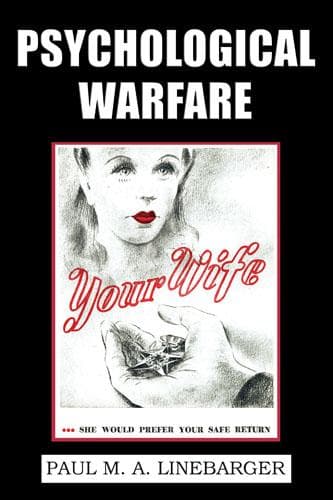
Psychological WarfareLinebarger, Paul Myron Anthony
History
Psychological Warfare
Linebarger, Paul Myron Anthony
Psychological warfare
=The Cold War.= In some respects the Cold War is not novel. It resembles
the intercivilizational wars of the past in which competing
civilizations with definite moral and political foundations fought one
another for final survival. This kind of warfare is very different
indeed from struggles waged between nations which have a common
civilization and which have a common interest in the preservation of
that civilization. The Americans of the 1950s are waging a struggle much
more like that between the Protestants and Catholics in the years
1618-48 than they are to the Civil War of 1861-65 or the Revolutionary
War of 1775-81. In some respects we Americans are back all the way to
the fight between the Aztecs and Cortez or the struggle between Chinese
and Chams in ancient Annam. What Mr. Lippmann calls merely a Cold War is
something deeper, bigger, and worse than any war Americans have ever
known before. The only parallel to it was the struggle between settlers
and Indians on our own frontier: our battles with the Indians at least
had the advantage of never leaving us with the hideous dread that the
American Indians might sweep a White and Christian civilization from
this continent.
=Nature of the Cold War.= The Cold War is therefore a struggle, the
beginnings of which can be found at any one of several dates (1848, 1917
and 1943 are some of those given) which is now being waged between
non-Communist states and a Communist group of nations. No one now living
can speak with assurance of the outcome. Only the most foolhardy of
optimists could visualize a world in which the better aspects of each
system would be developed and the factors common to each would be
underscored and strengthened as supports for a peace-seeking
international system under the UN. The struggle is larger than a war
because it comprises pre-belligerent, belligerent, and post-belligerent
activities both in global wars and in a possible general war. On the
Communist side the techniques include sabotage, revolution, conspiracy,
and fanatical organization. On the anti-Communist side a family of
para-military weapons is gradually being developed and may or may not be
thrown into the struggle. No war was ever as bitter or uncertain as this
one because war, whatever its demerits, at least commits the nations to
combat and to victory. War has the supreme merit of _decision_. The Cold
War does not: people have to fight it without knowing what it is or what
they would get out of it if they could obtain the advantage.[46]
Public-domain text, read in full here on John Shaqi.
Reviews
Reviews
No reviews yet
Be the first to share your thoughts on this work.
Elsewhere in the archive
Join the Discussion
Join the discussion
Sign in to leave a comment or review.
Sign InorCreate an account