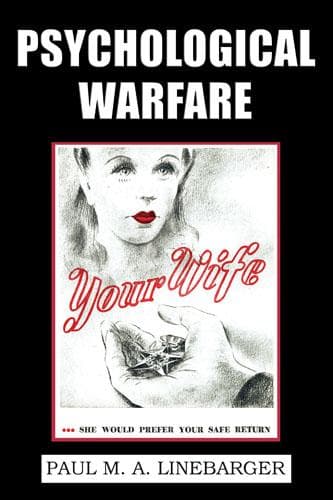
Psychological WarfareLinebarger, Paul Myron Anthony
History
Psychological Warfare
Linebarger, Paul Myron Anthony
Psychological warfare
[42] These suggestions are based on the comment of Major Martin Herz,
who prepared the leaflets at Anzio beachhead and subsequently was
leaflet expert at SHAEF.
[43] No author, publisher, place or date. Issued by the unit. The
reference is to page 55.
[44] The Department of the Army is understood to be preparing a Field
Manual and Technical Manual for Psychological Warfare which will
describe the doctrines and the equipment, respectively, to be used in
combat propaganda situations.
[45] In the postwar period a great many reflective publications began to
appraise what had happened in the PsyWar field. One of the best of these
is Daniel Lerner's _Sykewar: Psychological Warfare Against Germany,
D-Day to VE-Day_ (New York, 1949), which covers the European operation
in detail. This was followed by _Propaganda in War and Crisis_, edited
by Daniel Lerner (New York, 1951). A heavier work, covering many of the
same problems is _The Language of Politics_, by Harold D. Lasswell,
Nathan Leites and associates (New York, 1949). Leonard Doob's work on
propaganda, long the leading American text in the field, was issued in a
revised, postwar edition (New York, 1948); the postwar book does much to
put "psychological warfare" in perspective. A simpler text than Doob's,
useful for less advanced students, is Frederick C. Irion's _Public
Opinion and Propaganda_ (New York, 1950). A manual directly pertaining
to psychological warfare is _America's Weapons of Psychological Warfare_
edited by Robert E. Summers (New York, 1951); this also contains a
bibliography which is helpful to the layman. Three outstanding works
summarize the postwar propaganda position of the U.S. Government:
Charles A. H. Thomson's _Overseas Information Service of the United
States Government_ (Washington, 1950) shows the continuity of the
problem from war to peace; Wallace Carroll's _Persuade or Perish_
(Boston, 1948) argues the necessity of maintaining an opinion offensive;
and Edward Barrett's illuminating discussion, _Truth is Our Weapon_ (New
York, 1953), brings the story down to the Eisenhower Administration.
Public-domain text, read in full here on John Shaqi.
Reviews
Reviews
No reviews yet
Be the first to share your thoughts on this work.
Elsewhere in the archive
Join the Discussion
Join the discussion
Sign in to leave a comment or review.
Sign InorCreate an account