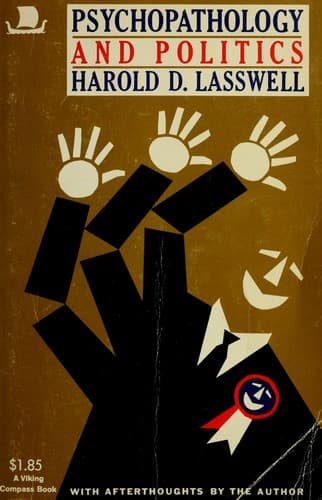
Psychopathology and politicsLasswell, Harold D. (Harold Dwight)
Science
Psychopathology and politics
Lasswell, Harold D. (Harold Dwight)
Personality and politics; Political science; Psychoanalysis; Psychology, Pathological
He never remembered a time when his mother and father, who were
divorced when he was eight, were on good terms with each other. They
seldom spoke, except to quarrel. This family background was reflected
in the mental life of the growing child. K was notoriously nervous and
timid. From a very early day he began to be preoccupied with why he
was different from everybody else in the world. His sense of isolation
and strangeness led him to believe that perhaps he was the only real
person in the world and that everybody else was an illusion. He would
sometimes come up wonderingly to touch his mother, and then himself,
to see if she, too, were real. He speculated on how he could get away
from the human shadows around him, and became convinced that he could
fly. Several times he laboriously climbed up on the seat of a kitchen
chair, spread his arms like a bird, and leaped into space. Every time
he crashed to the floor, his frightened mother rescued him, but he
always felt surprised and rather aggrieved that he should fall, and
secretly believed that he could fly after all. This type of reaction
characteristically appears where emotional conflicts in the home create
an acute problem of emotional orientation for the child.
As a small boy he was sent by his mother to follow his father when he
left the house, and to report where he went. K developed a strong sense
of guilt for this, and after the divorce was afraid that his father
would return and take revenge on him in some unknown and horrible way.
His father did occasionally reappear, and once invited the boy to spend
the night with him, but K was too frightened to accept.
The family often lived in the country, and the self-consciousness of
K in the presence of strangers was heightened by frequent removals
into new and often isolated places. One of the towns near which he
lived when about nine was on a frontier. Gun-play was frequent, and
K remembers having seen the corpses of men who had been shot down in
street brawls. There were ominous-looking fellows around town, and the
boy gave them a wide berth.
The death of his mother when he was twelve robbed K of his main
emotional support in a dangerous world. She died after two years of
suffering from an infected limb. She would also spit into bits of
papers and burn them in the stove. K wondered why she did this, and
later developed a reverie the importance of which will soon appear.
Public-domain text, read in full here on John Shaqi.
Reviews
Reviews
No reviews yet
Be the first to share your thoughts on this work.
Elsewhere in the archive
Join the Discussion
Join the discussion
Sign in to leave a comment or review.
Sign InorCreate an account