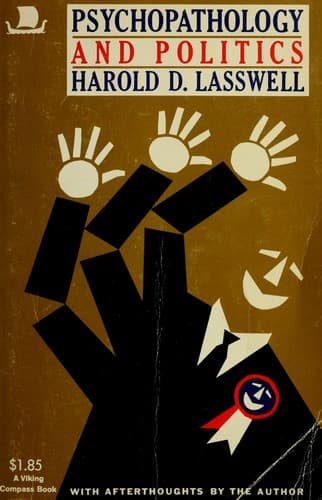
Psychopathology and politicsLasswell, Harold D. (Harold Dwight)
Science
Psychopathology and politics
Lasswell, Harold D. (Harold Dwight)
Personality and politics; Political science; Psychoanalysis; Psychology, Pathological
In marked contrast to his cringing demeanor abroad was his attitude
toward the older brother, ten years his senior. Time after time he
would pick a quarrel and pummel the older youth, until the brother
tired of the situation and gave him a sharp blow. Thereupon he went
to someone for comfort. Q’s father felt that the older boy might be a
little rough, but that the little fellow had something coming to him.
The mother was uniformly comforting, although she reproved both boys
for not behaving as brothers should.
The boys were profoundly hostile to each other, although usually
cordial. The older brother made himself conspicuous for his tenderness
during a serious illness of Q, running errands with alacrity, and
watching constantly by the bedside. When it became clear that Q would
live, the older boy’s devotion stopped abruptly, indicating the
unconscious basis of the exaggerated reaction. He was overreacting
against a death wish against his brother as an intruder between him and
the mother.
Q envied the achievements of his older brother, and often compared
himself unfavorably with him. The older boy not only stood at the
head of his classes, but earned his way by playing the violin.
Although Q stayed at the head of his classes, he was by no means as
self-supporting as his brother. The brother-hatred appeared in such
dreams as:
_Dream 1._--My brother is getting married. He is in a dress suit. A
long line of young men in dress suits are coming up to congratulate
him. As the first one reaches out his hand, he falls backward and
all the others fall over one another like tenpins.
_Dream 2._--My brother and I are walking down the street near
home. I hear a scream. An Italian is chasing a woman with a baby
who seeks refuge in a store. The Italian knocks her down. Then my
brother goes into the store and tries to deal with the Italian, but
is knocked down. I enter and knock down the Italian.
The brother-jealousy is of secondary significance in Q’s history. The
crux of the blood-phobia was a critical experience whose traumatic
effects were due to the strength of the affects which were mobilized
and repressed. Q slept with his father, and the blood-letting incident
aroused his slumbering desire for the death of his father and his own
active fear of suffering mutilation (castration). Blood derived its
significance because it involved a reinstatement of the most acute
phase of the conflict. To escape from it, Q fainted unless he succeeded
in getting out of the sight of blood at once. It is noteworthy that
Q did not at once faint when the razor cut the pimple; it was not
until the elaboration of the fantasy had continued, and the affects
had become greatly concentrated, that the blood came to signalize
an instant and overwhelming emergency from which a kind of suicide
(fainting) was the only escape.
The following terse dream expresses something of the underlying
situation:
Public-domain text, read in full here on John Shaqi.
Reviews
Reviews
No reviews yet
Be the first to share your thoughts on this work.
Elsewhere in the archive
Join the Discussion
Join the discussion
Sign in to leave a comment or review.
Sign InorCreate an account