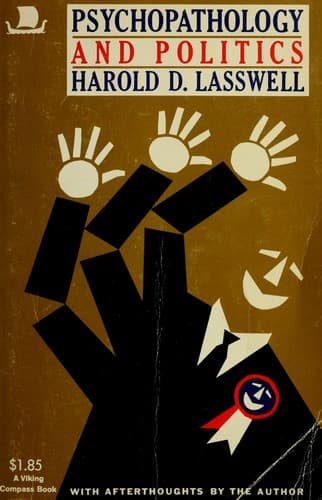
Psychopathology and politicsLasswell, Harold D. (Harold Dwight)
Science
Psychopathology and politics
Lasswell, Harold D. (Harold Dwight)
Personality and politics; Political science; Psychoanalysis; Psychology, Pathological
R’s story is not sufficiently detailed to show much about the
development of those reaction patterns which disposed him to meet
old age in such a way. He was the only child of a poverty-stricken
family who played by himself and got on well with his books. Some
local lawyers took an interest in him and helped him through school.
He read law and was admitted to the bar. After making a precarious
living for a number of years, he was elected to various local offices,
and then to Congress. He was reputed to be an impractical dreamer, and
enjoyed making rather fanciful speeches. His legislative career as
recorded in the _Congressional Record_ was undistinguished, containing
the usual quota of pension bills and “extensions of remarks” during
tariff debates. He was opposed to the annexation of the Philippines,
and hostile to imperialism; in this he went along with his party, and
likewise indulged a personal conviction. He practiced law desultorily,
after having been defeated for the legislature, and devoted himself to
study and writing. His one published volume is a vague disquisition on
human affairs, which accurately reflects the indeterminate, rhetorical,
and meliorative quality of his thinking. He married a woman of his own
age when he was a young man. There were no children.
When the paranoid rather than the manic-depressive strain runs through
the character, nebulous and all-embracing pessimism about the world
is sharpened to specific accusations. Everyone who is prominent in
public life is a potential object of such attacks. One might hazard
the conjecture that the importance of an individual in the community’s
estimation may be measured by the number of “crank” letters to him and
about him. One such crank, S, wrote a trunkful of letters accusing
public men of graft, of being dominated by “Big Biz,” and offering
suggestions to government officials. He complained of being persecuted
and victimized by prominent people, especially by Harry F. Sinclair,
the oil man. This was attributed by him to the fact that he had written
a letter to the Chief Justice of the Supreme Court calling His Honor’s
attention to the Teapot Dome scandal which was being ventilated in the
press, and naming Mr. Sinclair as the responsible party. Since then Mr.
Sinclair had prevented him from getting a job, and paid his own sister
to throw him out on the street. During his divorce proceedings he
wrote to the American Bar Association to protest against the “shyster
lawyers” who were representing his wife, and claims that Mr. Taft and
Mr. Root answered him in the papers the following day. When Mr. John
W. Davis was a presidential candidate he wrote to him, describing the
various attacks to which he, S, had been subjected. Mr. Davis neglected
to reply and did nothing about it, so S prevented his election, and
feels that Mr. Coolidge owes him something for being elected. “I wrote
to Hearst and I believe that turned the trick.” In this letter he
divulged the fact that Mr.
Public-domain text, read in full here on John Shaqi.
Reviews
Reviews
No reviews yet
Be the first to share your thoughts on this work.
Elsewhere in the archive
Join the Discussion
Join the discussion
Sign in to leave a comment or review.
Sign InorCreate an account