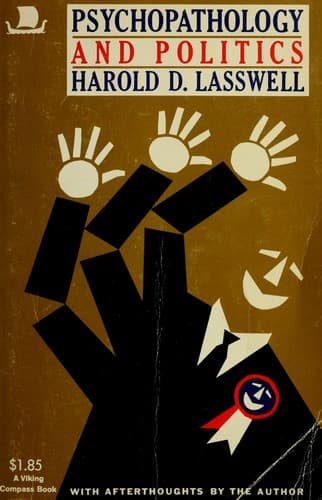
Psychopathology and politicsLasswell, Harold D. (Harold Dwight)
Science
Psychopathology and politics
Lasswell, Harold D. (Harold Dwight)
Personality and politics; Political science; Psychoanalysis; Psychology, Pathological
It will be remembered that Freud learned to predict the future course
of reminiscence by watching word slips, random movements, and many
other acts which were formerly dismissed as chance occurrences. He also
found that he could abbreviate the laborious efforts of the patient
to recall the traumatic (the original) episode by proposing various
interpretations. It is at this point that the cautious physician
and psychologist have picked serious quarrels with psychoanalytical
findings. They allege that the patient produces the kind of material
which the analyst suggests is to be brought forth, and that the whole
process is one of putting a rabbit in the hat which you triumphantly
extricate later on. They have seized upon the schisms in the analytical
fold, and declare that you eventually dream about anima figures if you
are analyzed by Jung, that you relive birth traumas if you are analyzed
by Rank, and that you welter in a galaxy of anal, oral, and urethral
symbols if you are deeply analyzed by Freud. You talk about inferiority
feeling if you work with Adler, and about castrative anxiety if you
work with Freud.
One might suppose that after thirty years of labor there would be in
existence a body of documents which could be consulted by a group of
competent specialists who were trying to reconcile their differences
and doubts about what actually goes on in the analytical interview.[61]
At the present time the interview situation is poorly reflected in the
notes taken by the analyst at the expiration of each period (if and
when he takes them). Nobody knows what processes distort the reporting
practices of different listeners, and nobody knows the value of the
published scraps. Since one of the avowed purposes of therapeutic
analyses is to bring the person to stand on his own feet and to stop
leaning on others, or upon symptom indulgences, personal relations
are usually broken off at the end of the interview. This obviously
impedes the possibility of following up the subsequent history of
the personality, and of ascertaining the stability of the supposed
therapeutic results. The case-history documents available in good
institutions have the advantage of representing the combined product
of several people who are in touch with the subject, and who may be
supposed to operate as a check upon one another. But these documents
are usually short, and betray the psychopathological slant of the ones
chiefly responsible. And these documents are typically incomplete
in reporting the whole personality of the subject on account of the
clinician’s interest in the more circumscribed disease phenomena
displayed.
Public-domain text, read in full here on John Shaqi.
Reviews
Reviews
No reviews yet
Be the first to share your thoughts on this work.
Elsewhere in the archive
Join the Discussion
Join the discussion
Sign in to leave a comment or review.
Sign InorCreate an account