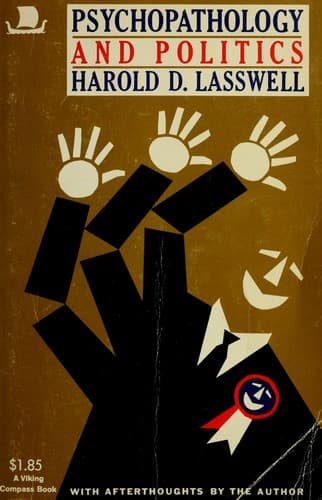
Psychopathology and politicsLasswell, Harold D. (Harold Dwight)
Science
Psychopathology and politics
Lasswell, Harold D. (Harold Dwight)
Personality and politics; Political science; Psychoanalysis; Psychology, Pathological
Our judgment of the “traumatic episode” is also influenced by the
subject’s certainty. If the subject reports that he believes what
he remembers, this has some value in raising a presumption. This is
especially true if the subject has fought against the idea, but it has
spontaneously continued to appear and plague his associations. But a
reported sense of certainty is flimsy stuff, unless this certainty
survives for some time. We know that individuals try to escape from
anxiety feelings by a flight into explanations, and that they are
ready to volunteer or to accept all kinds of interpretations of their
behavior rather than to continue to endure anxiety. This is the
basis for the credulity of the neurotic, and explains why everything
from mysterious “glandular unbalances” to “astral perturbations” are
accepted from time to time as completely adequate explanations of
personal troubles. So the subject’s reported certainty must survive
even disparaging suggestions and prolonged self-scrutiny, and become
emancipated from affect, if it is to be taken very literally.
Another criterion is the consistency of the reported episode with all
the other relevant facts. There must be something wrong about the
report that K was brutally punished by his father at a time which was
some years after the parent’s death.[63]
The obstacles which lie in the path of a research program which calls
for objective records of as much as possible of what transpires in the
interview situation are not to be minimized. The bulk of a verbatim
report of an hour’s conversation per day over several months is
almost overwhelming. But historians are accustomed to plow through
whole libraries of pages about Napoleon or Bismarck, and from the
standpoint of a comprehensive theory of personality development any
personality is almost as good as any other, although high elaboration
and distinguished achievement are advantages.
There are some points in favor of applying this technique of
personality study to people who are normal, at least in the sense
that they are suspected of normality by themselves and others. There
is a moral to be learned from some of Freud’s early mistakes when he
assigned critical significance to certain childhood experiences which
later investigation showed were very common. The clinical caricature
is invaluable for the high relief in which certain tendencies of
the normal are revealed. Indeed, “normality” is more difficult to
understand than disease, from one point of view, since it involves a
complicated integration of many tendencies, a flexible capacity to
snap from one mood, preoccupation, and overt activity to another, as
the changing demands of reality require. Normality is complexity and
integration, and it ought to be approached as directly as possible as a
control on the pathological.
Public-domain text, read in full here on John Shaqi.
Reviews
Reviews
No reviews yet
Be the first to share your thoughts on this work.
Elsewhere in the archive
Join the Discussion
Join the discussion
Sign in to leave a comment or review.
Sign InorCreate an account