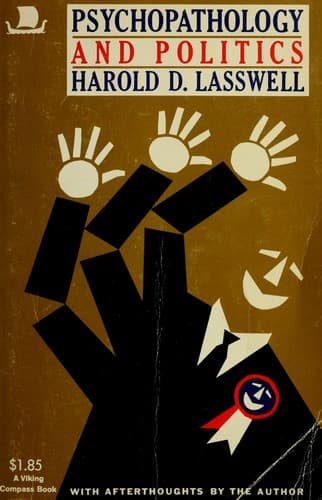
Psychopathology and politicsLasswell, Harold D. (Harold Dwight)
Science
Psychopathology and politics
Lasswell, Harold D. (Harold Dwight)
Personality and politics; Political science; Psychoanalysis; Psychology, Pathological
39. If you were to judge entirely in terms of your experience as
a member of this organization, what would be your judgment of the
honesty and efficiency of the public service and the party machine?
40. What political prejudices or philosophies were current among
various elements inside the organization?
41. Think of various members of this organization who were rather
typical. How did you act toward them when you met them? What topics
of conversation, of anecdote, etc., did you indulge in? What
activities in common were there?
42. Did you think that you were imposed upon by any members as you
look back upon it now? Did you estimate some of them too highly?
Who? Why?
43. Did you underestimate some? Who? Why?
44. Were you estimated too high or too low? By whom? Why?
45. What things apart from common dishonesty would have caused you
to lose standing in the organization? What opinions and activities
would have compromised you?
46. Did you risk loss of standing at any time by word or deed? Were
you tempted to? Why did you refrain?
47. When you tried to add others to the organization, whom did you
seek? What type of people, in general, were you interested in?
48. Did the organization live up to your ideal? Why?
49. Who were the most powerful ones in the organization at
different periods? What were your relations with them? What did you
do consciously to win them? Success? What did you do to antagonize
them? How did they take it? What, in short, was the attitude of the
leaders toward you?
50. Did you ever have a sense of frustration arising from your
failure to participate in discussions of policy, either because you
hesitated to express yourself or because you expressed yourself
badly?
51. What is your matured judgment of the utility of this
organization in society?
52. How did your organization connections help or hurt you socially
or any other way?
53. How did your outside connections help or hurt you in the
organization?
54. What, generally speaking, were your advantages and
disadvantages with reference to securing and holding a prominent
position in the organization?
55. In general, what place did this organization play in your life?
56. With respect to each one of your so-called free-lance or very
personal activities, answer such questions as these: How did you
happen to take it up? Upon what factors would your success and
failure depend? What did you do to manage the persons upon whom
success or failure depended? With what result? What reaction
did your experience have upon your outlook upon political life
generally?
INDEX
Abraham, Karl, 103, 150 n.
Adjustive thinking, 226
Adler, Alfred, 71 ff.
Administrators:
definition and histories of, 127 ff.;
general theory of, 151 ff.
Adolescence and politics, 187
Agitators:
definition and histories of, 78 ff.;
general theory of, 124 ff.
Public-domain text, read in full here on John Shaqi.
Reviews
Reviews
No reviews yet
Be the first to share your thoughts on this work.
Elsewhere in the archive
Join the Discussion
Join the discussion
Sign in to leave a comment or review.
Sign InorCreate an account