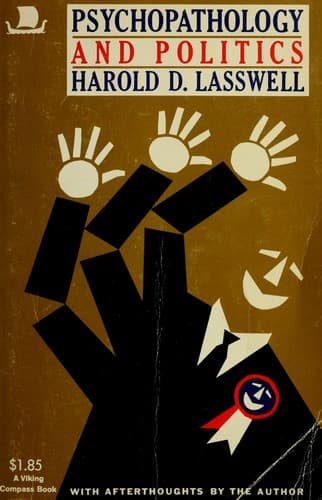
Psychopathology and politicsLasswell, Harold D. (Harold Dwight)
Science
Psychopathology and politics
Lasswell, Harold D. (Harold Dwight)
Personality and politics; Political science; Psychoanalysis; Psychology, Pathological
[52] The distinction between the crowd and the public is best developed
in the writings of Robert E. Park. Freud undertook to explain the crowd
on the theory that an emotional bond was forged by identification
of the individual with a leader, and by a process of partial
identification through the perception of this similar relationship
to the leader. He set out from the observation that when people are
interacting upon one another they behave differently than when they
are alone. The loss of individuality represents a relinquishment
of narcissistic gratification which can only come when libido is
directed outward toward objects. Freud’s theory applies strictly to
a special case of crowd behavior only. Crowd states may also arise
when interlocking partial identifications occur on the perception of
a common threat. Crowd behavior often arises before anybody assumes a
“leading” rôle, and rival leaders are “selected” by the crowd.
[53] _Studies in the Psychology of Sex_, I, 231.
[54] Kempf, _Psychopathology_, p. 704.
[55] Franz Alexander, “Mental Hygiene and Criminology,” _First
International Congress on Mental Hygiene_.
[56] For an appreciation of the rôle of the pathological person in
society see Wilhelm Lange-Eichbaum, _Genie-Irrsinn, und Ruhm_, and Karl
Birnbaum, _Grundzüge der Kulturpsychopathologie_.
[57] Something like this is no doubt the thought in Trigant Burrow’s
very obscure book on _The Social Basis of Consciousness_.
[58] This point was forcibly made by Beardsley Ruml in his speech
at the dedication of the Social Science Research Building at the
University of Chicago. See _The New Social Science_, edited by Leonard
D. White, pp. 99-111.
[59] I have suggested that those who write human biography should be
included among those who require this comprehensive training. See “The
Scientific Study of Human Biography,” _Scientific Monthly_, January,
1930.
[60] Modified and expanded from “The Psychoanalytic Interview as a
Method of Research on Personalities,” in _The Child’s Emotions_, pp.
136-59.
[61] See Harold D. Lasswell, “The Problem of Adequate Personality
Records: A Proposal,” _American Journal of Psychiatry_, May 1929. Also
Appendix B of _The Proceedings of the First Colloquium on Personality
Investigation_.
[62] We are now engaged upon studies of this kind at the Personality
Laboratory in the Social Science Research Building at the University of
Chicago. Harry Stack Sullivan is conducting a series of researches on
expression changes, with particular reference to schizophrenia, which
are of the greatest importance.
[63] The topic of reliable criteria will be dealt with in detail in the
reports upon experiments in progress.
[64] The best technical discussions of the nature of the analytical
situation are in the writings of Freud, Rank, Ferenczi, Nunberg, and
Alexander.
[65] Expanded from an article with the same title which appeared in the
_Journal of Abnormal and Social Psychology_, January, 1930.
Public-domain text, read in full here on John Shaqi.
Reviews
Reviews
No reviews yet
Be the first to share your thoughts on this work.
Elsewhere in the archive
Join the Discussion
Join the discussion
Sign in to leave a comment or review.
Sign InorCreate an account