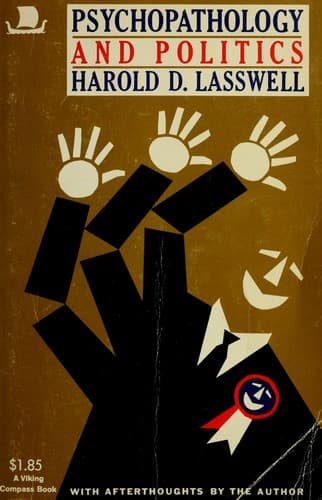
Psychopathology and politicsLasswell, Harold D. (Harold Dwight)
Science
Psychopathology and politics
Lasswell, Harold D. (Harold Dwight)
Personality and politics; Political science; Psychoanalysis; Psychology, Pathological
During these exciting troubles he became a socialist and joined the
socialist party. He had sympathized with the hard lot of the poor
since he could remember, and had cast his vote for Bryan as a symbol
of protest against the indifference of the privileged classes to the
privileges of anyone but themselves. His favorite college professor had
lost his job during the anarchist hysteria, when he came out against
the “judicial murder” of the Haymarket suspects. A was profoundly moved
by the spectacle of a man who backed his precepts of independence
with sacrifice for their sake. The argument which finally won him for
socialism was that political democracy is impossible until economic
democracy is realized, and that socialism is simply democracy in
industry. The principles of democratic brotherhood, once put to
practice in the world of work, would soon govern public relationships
of every kind.
His new convictions opened to A a new field of agitation and publicity.
Ignoring or overcoming the coolness of certain “horny-handed” elements,
he rushed into the little band of socialists, and was presently the
congressional candidate. In this campaign he conducted a whirlwind tour
of the district and enjoyed himself immensely.
A finally married a capable, motherly school-teacher whom he had known
for several years, but whom he had been prevented from marrying until
the death of her parents, who heartily disapproved of him. During his
bachelor years in the ministry he had certain knowledge that various
women were far from averse to becoming the preacher’s wife or mistress.
One married woman became the foremost worker in the church and
passionately assured him, “I am at your service day or night.” Another
woman, whom he barely recognized, came to the pastor’s study, declaring
that they must be married at once and “end this awful agony for both
of us.” He had not been aware that any agony had begun, and was in no
mood to begin it. He recognized that a wife would be a protection, but
most of the women who threw themselves in his way were so homely that
abstinence remained a pleasure as well as a principle.
For many years there had lurked in his mind the fear that he might not
be potent, and he was humiliated to find that he was at first unable to
consummate the sexual act. Since he first attempted sexual intercourse
when nearly fifty, and had practically never masturbated, his troubles
were not atypical, and they fortunately proved to be transitory. He
regretted having failed to consult a physician before marriage, and was
not at ease until the first of his children came.
Public-domain text, read in full here on John Shaqi.
Reviews
Reviews
No reviews yet
Be the first to share your thoughts on this work.
Elsewhere in the archive
Join the Discussion
Join the discussion
Sign in to leave a comment or review.
Sign InorCreate an account