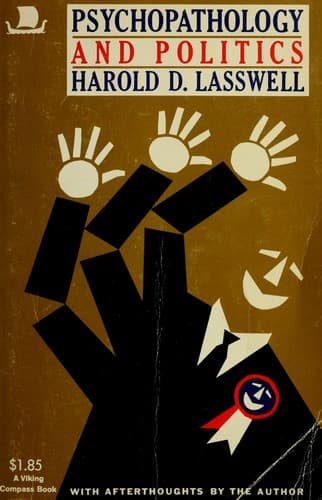
Psychopathology and politicsLasswell, Harold D. (Harold Dwight)
Science
Psychopathology and politics
Lasswell, Harold D. (Harold Dwight)
Personality and politics; Political science; Psychoanalysis; Psychology, Pathological
Shortly after marrying, A came to the end of his financial resources,
and found it necessary to relinquish his lecturing for other work
until a suitable congregation should requisition his services. When
a call finally came, the war broke out in Europe, and A denounced it
with his customary ardor. He had read a book which popularized Prince
Kropotkin’s thesis that mutual aid and not struggle is the key to
the evolutionary process. War was irrational because it contravened
the principle of mutual aid, and it was un-Christian because it
set the hand of man against his brethren. As the hour of America’s
participation drew nearer, A saw that his outspoken position would
cause trouble. But he was accustomed to take a radical view and stick
to it, and the idea of compromising his independence for the sake
of family obligations was intolerable. His characteristic optimism
also misled him into overestimating the amount of pacifism which his
congregation would put up with, and soon he was forced to resign.
A was left financially high and dry, and rather hoped that his wife
would be willing to starve with him, if need be, as a gesture of
sanity in a war-mad world. He was left financially dependent upon his
family, and upon such support as was forthcoming from wealthy radical
sympathizers. Since his own professional opportunities were curtailed,
and he never applied for other types of work, he was left dependent
upon others. He was somewhat embarrassed by this, but was never
depressed by it, or by the social ostracism which was entailed by his
unpopular stand. As he once expressed it, “melancholy is alien to a
fighting nature.”
Looking back over A’s career, certain private motives appear which were
well organized in his early family life, and continued to operate with
considerable strength during his adult years.
A had a strongly repressed hatred for his brother. He was consciously
aware of his own coldness toward the brother, but succeeded in barring
from consciousness any recognition of the emotional charge on this
attitude. The older boy was his rival for the affection of his father,
and A’s quickness and boldness were cultivated in an effort to outstrip
his brother. He showed many of the traits of the over active younger
child, as Adler has frequently described them. A felt rather ashamed
of his brother, who went through school and college with no special
distinction, and whose modest subsequent career was prosaically
respectable. A struggled to keep hostile thoughts about his brother out
of his mind, and sought to keep his attention away from the brother by
corresponding or visiting with him infrequently.
Public-domain text, read in full here on John Shaqi.
Reviews
Reviews
No reviews yet
Be the first to share your thoughts on this work.
Elsewhere in the archive
Join the Discussion
Join the discussion
Sign in to leave a comment or review.
Sign InorCreate an account